ACEMAGICIAN AM06PRO Mini PC, AMD Ryzen 7 5700U (8C/16T
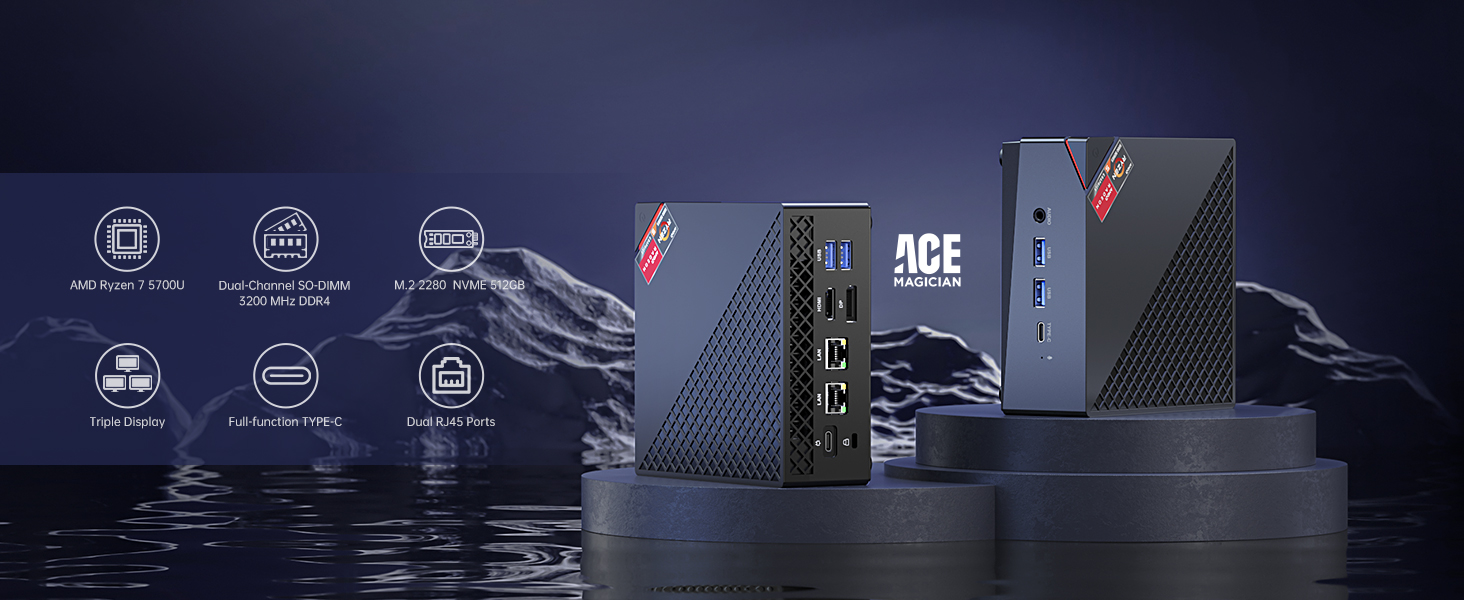
ACEMAGICIAN AM06PRO Mini PC, AMD Ryzen 7 5700U (8C/16T, up to 4.3 GHz), Pro Desktop Mini PC 32GB RAM DDR4 512GB M.2 2280 NVMe SSD, Dual Ethernet/WiFi6/4K Triple Display for Studio and Gaming
Small Mini PC
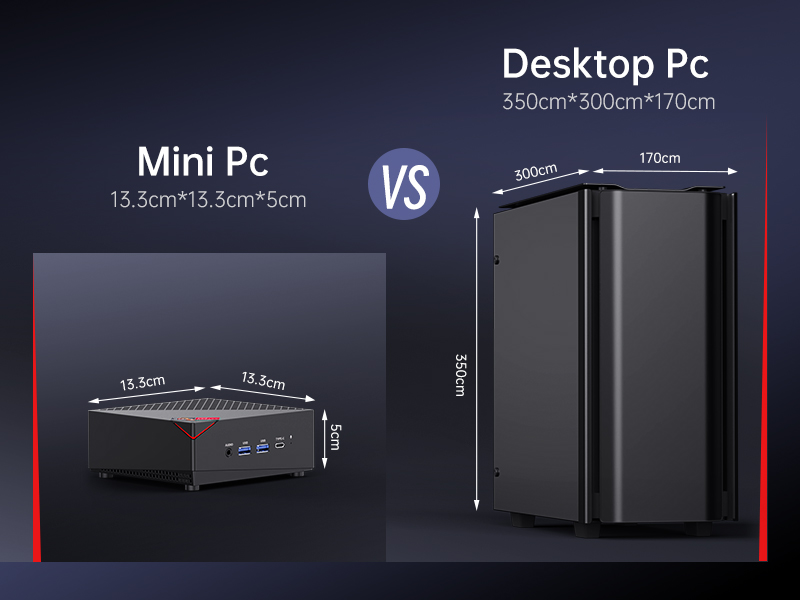
Compact and easy to carry MINI PC, which means you can take it anywhere, whether to the office, in hand luggage for plane travel, or in a backpack. Compared with traditional desktop PC, ACEMAGICIAN mini PC will be more in line with the needs of modern life, mini computers will be the best assistant in our life and work.



ACEMAGICIAN, MINI SPACE, BIG WORLD
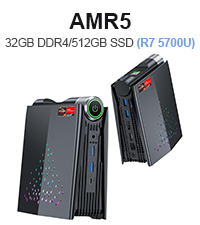 AMR5 Ryzen 7 5700U 32+512 | 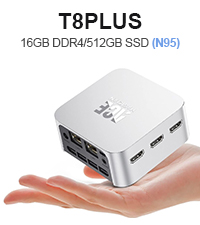 T8PLUS N95 16+512 | 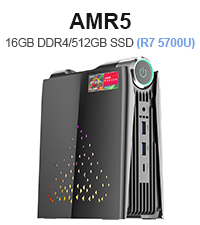 AMR5 Ryzen 7 5700U 16+512 | 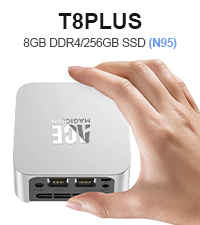 T8PLUS N95 8+256 | 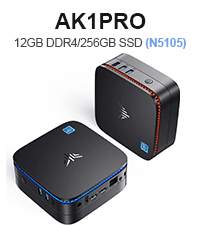 AK1 PRO N5105 12+256 | |
| Customer Reviews | 4.5 out of 5 stars 557 | 4.5 out of 5 stars 322 | 4.5 out of 5 stars 557 | 4.5 out of 5 stars 322 | 4.4 out of 5 stars 666 |
| Price | £559.99 | £239.99 | £459.99 | £179.80 | £169.99 |
| PROCESSOR | AMD Ryzen7 5700U | Intel Alder Lake-N N95 | AMD Ryzen7 5700U | Intel Alder Lake-N N95 | Intel Celeron N5105 |
| OPERATING SYSTEM | Windows 11 Pro | Windows 11 Pro | Windows 11 Pro | Windows 11 Pro | Windows 11 Pro |
| RAM | 32GB DDR4 | 16GB DDR4 | 16GB DDR4 | 8GB DDR4 | 12GB DDR4 |
| Dual Band WIFI | 2.4G/5G | 2.4G/5G | 2.4G/5G | 2.4G/5G | 2.4G/5G |
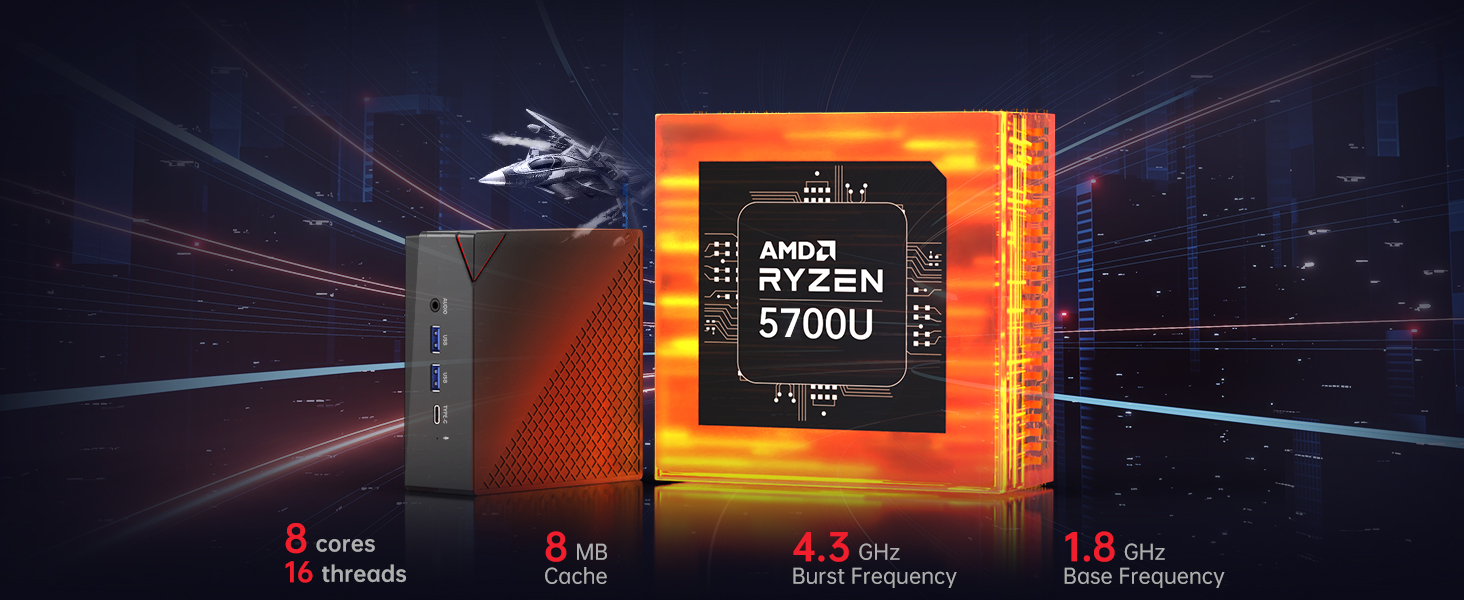
| Base/Burst Frequency | 1.80 Ghz/4.30 Ghz | 1.7Ghz/3.4 Ghz | 1.80 Ghz/4.30 Ghz | 1.7Ghz/3.4 Ghz | 2.9 GHz |
| VIDEO INTERFACE | HDMI+DP+Type-C (4K@60Hz) | 3X HDMI (4K@30Hz) | HDMI+DP+Type-C (4K@60Hz) | 3X HDMI (4K@30Hz) | 2X HDMI (4K@30Hz) |
| BLUETOOTH/WIFI | ✔ | ✔ | ✔ | ✔ | ✔ |
| AUTO POWER ON | ✔ | ✔ | ✔ | ✔ | ✔ |
| Weight: | 1.13 kg |
| Dimensions: | 23.9 x 18.6 x 7.4 cm; 1.13 Kilograms |
| Brand: | ACEMAGICIAN |
| Model: | AM06PRO |
| Manufacture: | ACEMAGICIAN |
| Dimensions: | 23.9 x 18.6 x 7.4 cm; 1.13 Kilograms |
It works just like any other gaming pc half the noise and the size. I unfortunately broke my charger and I’m having a hard time finding a suitable replacement so if I could buy another one then I’d give it 5 stars!!
It works just like any other gaming pc half the noise and the size. I unfortunately broke my charger and I’m having a hard time finding a suitable replacement so if I could buy another one then I’d give it 5 stars!!
Customer suppo
I had an issue with my new computer and once I contact Team MiniPC they help me to resolve it.
First by guiding me throughout troubleshooting and later on to return item to them.
All in all, positive experience and great customer support with satisfactory result.
Decided to try a mini instead of a desktop when replacing my 11to desktop. For what I use it for and my budget, it made sense to give it a shot. It’s a great choice for a 2nd PC or for casual, low-stress use. It’s plenty fast and with 16MB of RAM it can handle multiple applications running. I’ll never go back to an empty, metal, mostly empty desktop again.
Decided to try a mini instead of a desktop when replacing my 11to desktop. For what I use it for and my budget, it made sense to give it a shot. It’s a great choice for a 2nd PC or for casual, low-stress use. It’s plenty fast and with 16MB of RAM it can handle multiple applications running. I’ll never go back to an empty, metal, mostly empty desktop again.
Value for money is the key. What an incredible little machine.
What will you do with this machine? If you’re going to play yesterday’s bigger games, or today’s moderate ones, then this computer has everything you need. (Hopefully) No one is trying to get a gaming computer for under 300 that’s serious about gaming (because they know what price point it takes). At most I might do some light video and audio editing, as well as VTTRPG (Roll 20), and though these might take *some* juice to run, they don’t take a lot.
Pros (+) and Cons (-)
++ Firepower: As long as you’re not pushing for high end gaming, this thing is a powerhouse. Civ 6 (with an end game save – full world revealed and tons of units) ran so smoothly, it was impressive. A/V processing is going to be easy with this thing.
++ Size: It’s not a laptop but it’s HIGHLY portable, easy to take to a friend’s house or some friendly environment where you may have access to a display and electricity.
+ Easy to upgrade: I haven’t tried it yet, but one reviewer’s vid definitely makes it something I’ll attempt within the next month or two. I’m adding a 1 or 2 TB SSD.
= One reviewer said Windows 11 wasn’t the real deal, but when I clicked activate, it did just that. I was already signed into Microsoft, so that *may* have had something to do with it, but I just verified that (as far as Windows is reporting) it’s legit.
– Port layout: It’s not worth a deduction, but the Type C output is on the front and things are a little cramped; and some of us prefer an audio output on the back, but those are small knocks.
I’ve only had this 2 days, so may have to come back and update my review.
Great system for Emulatio
The setup was simple. Google chrome was already installed which leads me to believe they boot these from set images, which would make sense. My hope is the activation sticks, it has so far but at some point I’ll end up doing a clean install of my own and we’ll see how that goes.
For work:
This thing will get the job done, fast boot, multitasking, I’ve attached it to three monitors using the USBC for the third video source and it did not hiccup once with heavy excel spreadsheets calling to API queries and PowerBI, while simultaneously streaming a movie from my Plex server.
For Gaming/emulation:
I haven’t installed any current gen games on this. But…I have been able to accurately emulate the second generation of Sony without issue. In fact, I was able to upscale all the games played to 1080p and smooth when choosing the onboard AMD graphics for rendering. This includes all generations of Sega consoles, and the last generation of N*ntendo (the one with the screen on the controller, name not to be stated for obvious reasons). I have not attempted the third generation of Sony on here yet and don’t really plan to as I’ve got all that still hooked up, but for those wondering if it would run NFSU equivalent games from PS*2, it will.
Good build quality, performs well, has adequate expansion....love it so fa
This thing is great. Takes up no space and works like a champ. The performance is good enough for anything I will need to do and is better than the Intel i7 that I am retiring. If the quality of this machine is indicitive of the longevity then it should last long enough to live until Microsofts next scortched earth upgrade for the masses.
Based on my initial impression and the cost , i would recommend this. You can’t go wrong for general use and light gaming.
Super quiet!! Amazing improvement to AM07
I’ve tried a few of these and there are slight but significant differences between the models despite fairly similar specifications. This one is most similar to the AM07 I tried, which was of similar square design and came with VESA mounting, making it either a great HTPC or seamless office PC. There is, however, a major difference: and that’s noise!!!! This one is dead silent even at 100% CPU utilization. It’s able to mine cubic at 28 it/s using just 20w and is only 36db loud (my desktop computer with a 360mm AIO is 50db).
It’s not a tool-less open like the AM5 but the four screws on the bottom are easy to remove. This model has the ability to add a 2.5″ drive (ribbon cable in the box) but only has one NVME slot.
Amazing little compute
Generally, if you are after one of these little PCs, you have something in mind in terms of its usage.
For me, I’ve been using it for a retro gaming machine and media centre.
Basically, I’m loading this little guy up with videos and with older games and then plugging it into my television via HDMI and using it to enjoy media. Because it’s so small, it’s easy to plug in when I need it and then put into a small storage box when I’ve finished with it. Via USB and Bluetooth, I’m able to use a range of controllers to either play my games or change channels.
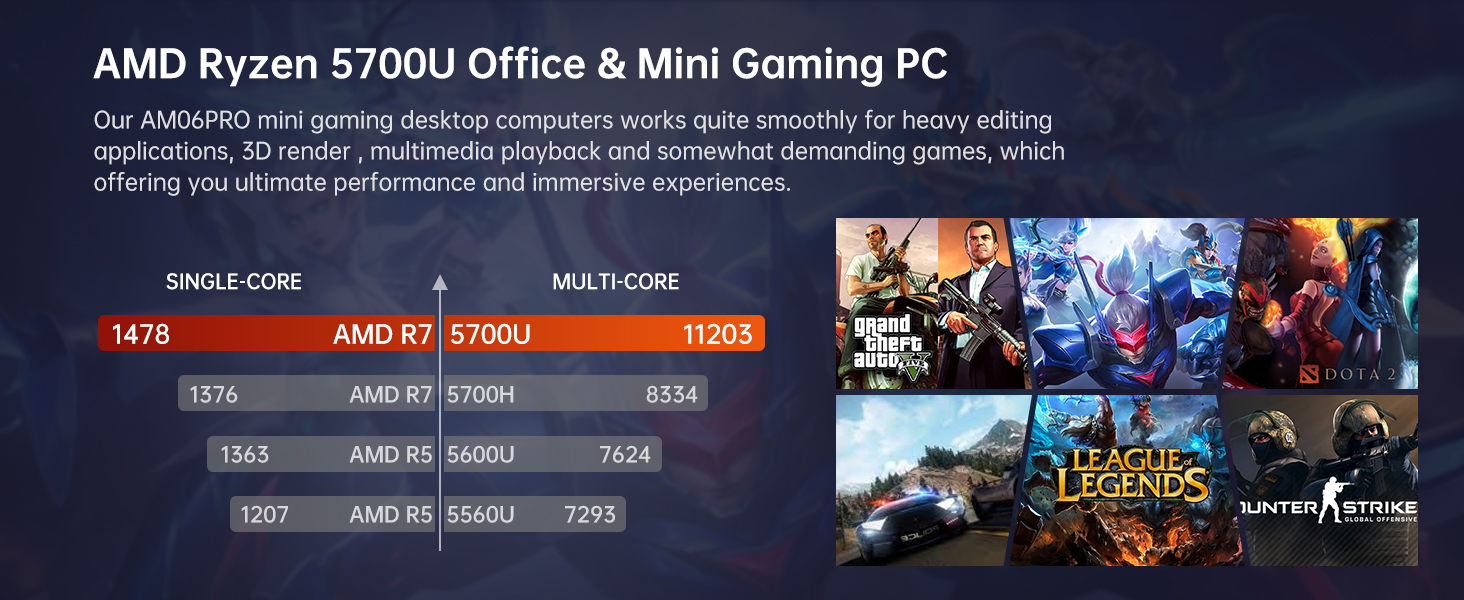
That said, it’s possible usage is very broad. With an AMD Ryzen 5700U and Radeon RX Vega 8 Graphics, you are getting a mobile processor that is very capable. Whether you are wanting to create documents for work, watch movies or play pretty much any game on lower to medium settings – bar AAA titles – this PC should have you covered.
The storage space of 512GB is also pretty decent and means you don’t have to mess around too much with external storage.
Overall, I’m amazed at how much power such a small device can hold. Everything I’ve thrown at it has run great and I also appreciate how quiet it is whilst running.
After extensive research into affordable gaming PC options, I stumbled upon this absolute gem! Let me just say, it’s nothing short of spectacular! While my wife and I aren’t hardcore gamers, we do enjoy some casual gaming sessions, and this PC has exceeded all expectations.
Running World of Warcraft on the highest graphics settings is an absolute dream with minimal glitching – just a few blips here and there, hardly noticeable. Even tackling Escape From Tarkov is a breeze, with minimal performance issues.
The best part? This PC operates like a well-oiled machine, devoid of any annoying bloatware or unnecessary clutter. Plus, the ability to upgrade components as needed ensures longevity and adaptability to future gaming demands.
What’s more, I didn’t have to break the bank for one of those oversized, flashy RGB towers that would’ve cluttered up our space. This sleek, efficient setup fits perfectly into our lifestyle and budget. Needless to say, we’re absolutely thrilled with our purchase!
I bought this because of the dual Ethernet ports, and it seems to always be on sale. After a few weeks of searching, I wasn’t able to find another product that offered the same performance for the price point ($269). I have Google Fiber 1 gigabit internet, and my old router wasn’t cutting it. I bought this mini-PC for the sole purpose of using it as a home lab and to try my hand at setting up Opnsense. You can boot into BIOS by spamming the DEL key at startup and completely bypassing the Windows setup. I reformatted the NVME immediately for openBSD (Linux) and installed OPNSense in about 15 minutes. Opnsense identified the Ethernet interfaces immediately, and I did not need to install any drivers. After switching my RAX10 Netgear router into AP mode (not bridge mode; I made that mistake and had to reset it), I plugged it into the LAN port, and it worked immediately. I installed Adguard Home for DoH DNS and adblocking. The hardware is probably overkill, but there is a night-and-day difference. Before using this as my router, I got maybe 200 Mbps of download and around 9–30 Mbps of upload over wireless, 500–600 Mbps of download, and 20–30 Mbps of upload over Ethernet. (I have about 10 devices connected to the old router at any given time.) After using this mini PC as my router, I get a consistent 500–900 Mbps over wireless and a 300–900 Mbps upload. Over Ethernet, I’ve seen a consistent 990 mbps download and 990 mbps upload. My old router was clearly the weak link here. I wouldn’t recommend using this mini-PC for a hardware router if your speeds are greater than 1 gig. The 1 gigabit Ethernet port will clearly be a bottleneck. For the price, it beats any netgear wifi router by a mile. Pair it with a TP-LINK Switch, and you have a makeshift home lab that’ll run anything you need.
TLDR: Use this as a router. improved speeds by 10x. 1gig Fiber.
I’ve been pimping up an old custom machine for last 11yr, it’s still goes well.
However I took the plunge and decided to buy this for 339.99 with – 200 discount.
I have not been disappointed, with 32GB of Lexar DDR4 RAM @3200Mhz (There is more than a field of them lol) it’s plenty.
An “AirData 512GB M.2 2280 NVMe SSD, boot time around 5.8secs…!
And there’s even room for a 2.5” sata 2.TB HDD / SSD (i’ve asked manufacturers if it can take more than 2.TB)
The Ryzen 7 5700U (The U suffix donates low power cpu) but with 8 cores and 16 logical cores with bursts of 4.3Ghz it displays HDR on my Philips 65 UHD 4k and the integrated AMD Radeon graphics plays 4k footage / games with ease.
You can connect 3 displays (2 is enough for me)
If your phaffing around with and oldish desktop I would recommend this, plus windows 11 Pro out the box (windows 10 support ends 2025)
&
Haven’t had it long but I second everyone’s opinion on applying better thermal compound. The fan was running full blast just doing windows updates. I took it apart and applied new thermal compound to the cpu/heat sink. Now fan now runs at low speed and I have yet to hear it power any higher aside from initial boot. I used noctua brand, but your choice of any PREMIUM compound should do. Would give it 5 stars but the fact it got hot and I had to take some intervention knocks off a star. Other than that it’s fast and works well. If you like upgrading your own pc components get this, applying thermal compound wasn’t too bad and it’s extremely easy to change out the ram, nvme drive and add an SSD. It’s basically a laptop board in a little box.
Excellent value for money
Use in our showroom to display our products and show customers their kitchen, bedroom and bathroom plans. Small size and great connectivity means we can hide it in a wall unit and display on a 50″ TV.
Small size for a big PC
This mini PC maybe small but it is a decent piece of technology for the price. Being able to use it on a 43 inch TV means not having to balance a 10 year old but capable laptop in my lap that weighs a ton and needs plugging in after a hour or two. It’s also seems more responsive and faster than my laptop despite not having an i3 core processor.
This unit has been quite impressive. It’s eats everything I throw at it, with plenty of appetite left over. Very often I have a large number of tabs open, including with FB, and this unit has no problem whatsoever running all of them with ease. And though the games I do have aren’t newer, the unit still runs them with no issues whatsoever, and at higher settings than I would have expected. The unit is very quiet, and only when I’ve been doing more intensive activities have I heard the fan come on, and even then it’s whisper quiet.
I bought my AM06 Pro in May, and the version I have has the Ryzen 5 5600U CPU. I only used the unit for a couple of days before upgrading both the RAM and storage, but not because it was necessary. With the stock RAM and storage the unit was working perfectly. I simply upgrade PCs as a matter of ‘future proofing’, so a unit is still great for what tomorrow throws at it too.
It’s quite unique, with the power button being at the top left corner rather than being on the front of the unit. At first this worried me a little, as in possible accidental shutdown, but this hasn’t happened. The amount of pressure needed is enough that this isn’t a problem, and I’m not accidentally touching that corner of the unit like I feared I might, so the fear was ultimately unfounded. And, to be honest, the power button just looks pretty neat.
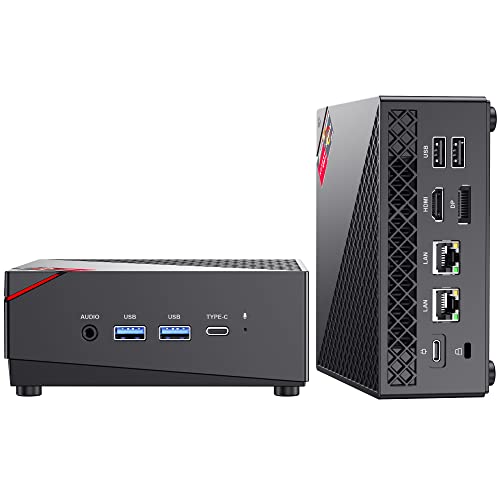
The front of the unit has a combination audio port, two USB 3 ports and a USB-C port. It also has a small, built in microphone, though I haven’t used it. The back has two LAN, one HDMI, and two USB 3 ports, as well as a DisplayPort. It also has the power port, which I’m happy to say is USB-C rather than a barrel connector. I find that barrel connectors can get fairly loose over time, but USB-C seems less apt to do this, so having the USB-C port for power is a good thing.
The unit also has room for an add on 2.5″ SSD, though I haven’t used this with mine. Still, it’s a fairly easy process to install the drive if you need to and it’s a great way to considerably expand its storage.
Overall I couldn’t be happier with this unit, and I wouldn’t hesitate to recommend it to people looking for a good desktop replacement that can also be used for gaming. You aren’t going to be able to run newer games using high settings with this, but the unit does pretty well regardless.
So i purchased this device because it had 2 NIC’s and I wanted to replace my existing untangle gateway device with something newer, using it for untangle however, i replaced the SSD and installed untangle to that SSD and it recognized the 1Gb NIC but didn’t recognize the Intel 2.5Gb NIC at all 🙁
(using UT 16.4 – will try 17 as well later JIC it can recognize the 2.5 Gb NIC)
** IF ** i could have used this as my replacement gateway device it would have been very good as the CPU is decent, the RAM doesn’t seem to be crap and whilst the SSD was SATA, it was still faster than a traditional HD and easily replaceable (which i did for a Samsung 980 which is NVME, PCIe 3×4 M.2 2280 which was cheap and MUCH faster)and it uses only 65W – but I’m going to have to return it as it’s unusable for this purpose.
For a desktop PC replacement overall however, this is very good – i like the size, and there were lots of ports to simply swap my laptop out and plug everything else in and it all just worked (in Windows 11)
In terms of upgrade-ability, it’s fairly easy to get inside of the case and you can easily swap the SSD, RAM and even the wireless card (although i didn’t even notice what type or brand) but that’s all you could ever really want to do with this (and in it’s factory state I’d just upgrade the SSD and call it a day)
For a mini-pc usage replacing an older desktop PC – this is VERY GOOD and perfect for 95% of general users who don’t game on their work PC and just want to surf and using office with lots of CPU power to spare.
For my requirements this fell short but not because of hardware but rather a software shortcoming of Untangle and Debian with Intel 2.5GB nic’s.
For everyone else, using windows 11 – this rocks (as long as you don’t want to game) and the 65W total power usage is great for lowering the electric bill compared to a traditional PC, a good green choice and it takes up next to no space compared to a traditional PC.
Just don’t use it for Untangle.
I bought this computer as a backup for my home computer, mainly for office work and watching movies/videos (not for gaming).
I’ve only been using it for a few days but so far I’m very happy with it, honestly the computer exceeds my expectations. It’s small, fast and quiet.
I don’t think the 512GB SSD installed will be enough for me, so I installed an additional 2.5 SSD. I have to say there are no installation instructions and I had to contact support. They responded quickly and sent me a video with installation instructions. It turned out to be very simple and took no more than 5 minutes. Only an SSD drive is required for installation: the necessary cable is included with the computer.
The installed hardware meets my current requirements. Some reviewers have noted that the installed M2 drive is not very fast, and the RAM is only 16GB. I now have 437 GB of system disk space and 10 GB of physical memory free on my virtually “clean” computer (I have only installed a few favorite applications). If needed, the device can easily be upgraded to 64GB of memory and a faster, higher capacity SSD drive.
It was also mentioned that it is not possible to view the BIOS using only the HDMI output. This is true, and viewing the BIOS is somewhat difficult. You have to turn off the computer and press the DEL key. On the other hand, you can use a ‘DP to HDMI’ cable if the monitor does not have a DP input.
The computer has 2 LAN ports. To be honest, they are unlikely to be used by many people since Wi-Fi works fine. But these ports work fine as well.
It was also mentioned that the charging port can be used as an additional USB port if power is connected through the dock. I have tested this feature and it does work.
As for temperature. During normal office work, the surface temperature of the computer is just above 100 degrees Fahrenheit. The fan very rarely comes on during work, usually when booting up. It is quite noisy, but most of the time the computer is completely silent.
Nice little machine
I decided to replace my Android media player with this and am very pleased with it. Mine was a return which I got a little cheaper. I think somebody didn’t like it – probably expecting too much on the gaming front I suspect. I have a lot of old TV series saved as only mediocre resolution video but with the K-Lite codec pack installed using the bundled video player in the Standard install download they are upscaled well and downloads with newer codecs all play perfectly on my 4K TV.
Mine came with Windows 11 Pro 21H1 but I force updated that to 22H2 using the upgrade assistant. The newest 23H1 wasn’t offered just the features try out optional patch but probably will come soon enough. The upgrade ran through smoothly enough once I sorted the annoying default power setting which put it into sleep mode and I thought it had hung. It took a while but this is a fairly low end machine. Mounted on the back of a monitor with the provided bracket it would make a nice all in one for most people imo. It is overkill for my use as a video player and browser but that just means it isn’t stressed and runs only warm not hot. I haven’t heard any fan noise.
Quite why it gets listed as 512GB ROM is a mystery. It has an internal 512GB SSD that performs adequately and room in it to add another SSD. I keep all my video on USB3 drives and it has 2 USB3 and 2 USB2 slots. I opted to use a small bluetooth keyboard which I already had and bought a cheap bluetooth mouse to go with that. Should anybody need to get into the BIOS settings then a USB based keyboard either wired or wireless will be needed.
Versatile and solid value.
Pretty nifty little machine. Haven’t had any issues booting it up and rigging it up as a simple media center connected to a TV. For non graphically intensive games, also seems to perform fine for the price point. Minor issue is that it can heat up a bit.
Outside of that, it is solid value, especially on sale at <$260.
This is a review for the AM06 Pro with Ryzen 5 5625U, 16 GB RAM, and 512 GB SSD.
Overall, this was a great value at the price I purchased. The unit has good build quality and great IO options. It has a few under-advertised features such as DP Alt Mode out for the rear USB-C port and support for a 2.5″ SATA drive.
The one major build issue I found was the poor quality and application of the thermal compound. The stock compound has a poor texture, and there were a few contact voids between the CPU and heatsink. I replaced the original compound with a thin layer of Thermal Grizzly Kryonaut and got significantly better temps under load.
I’ll also note that based on teardowns posted by other reviewers over the last few months, it seems the internal build quality and components for this model can vary slightly. For example, I’ve seen units with a FORESEE SSD instead of AirDisk, and I’ve seen ones without any metallized foil tape covering the IO port shields.
Finally, if you want to squeeze the most performance out of the CPU, you’ll want to adjust power limits in the BIOS or use software like the Universal x86 Tuning Utility to raise the power limit to its maximum. At stock, my unit ran with a power limit of ~15W. This can be raised to a maximum peak power of ~27W for a few minutes or long-term sustained output of ~23W at 95C on this heatsink.
I’ve had for about a month and so far, I’m very impressed with the performance of this mini computer. It is plenty fast for casual/normal usage and can handle some light to moderate gaming too. I doubt you can run most current games in anything near max settings, but I’d assume they should be able to run on lower quality settings. Plenty of RAM and disk space available after installing a no-frills Windows 11 Pro. My only concern is the quality/longevity of the components as the memory and SSD are unknown although the memory appears to have Micron chips (I upgraded the RAM with some G.Skill 64 GB paired sticks with no issues and am planning on upgrading the SSD to a 2 TB PCIe 3.0 M.2 soon). My other concern is that as others mentioned, the CPU does seem to run hot sometimes under load, like close to 200 F. Maybe that is within specs for this processor, but comparing to a full tower gaming rig I have with a large liquid cooler that can keep a 125w TDP CPU at about 110 F under full load and at about room temperature (~70 F) at idle, hitting 180-190 F on a 15w TDP CPU seems high but maybe that is normal and a consequence of the small form factor. Under idle and low loads, it is around 115 F which is not bad. The fan only ever gets loud enough to hear when it is approaching the high temps and so is very quiet under light usage. It really doesn’t use much electricity which is very nice. Overall, I’m very pleased with the performance and low power usage of this mini computer. I’m hoping it will hold up and give me good usage for several years.
I’ll keep this short and sweet. I’m an IT “expert” with many years of experience in home, small business and enterprise hardware and software solutions. I’m pretty blown away with the value of ACEMAGICIAN Ryzen 5 mini PC. The Windows 11 Pro PC experience is super snappy and much faster than my ~2 year old Windows laptop (valued at ~$1k at the time) that I have docked to one of my desktop monitors. But I didn’t stay with the Win11 configuration for long. My purpose was to use this mini PC as a pfSense router to help increase network utilization and stability, and it delivered in spades. Although I would’ve liked all Intel networking (currently it’s Intel 2.5G and Realtek 1G and Realtek Wi-Fi), I’m still plenty happy. Thanks to a previous user’s suggestion, I installed the latest build of pfSense to get the Realtek Ethernet to work. Offloading the routing functions of my Linksys Velop Mesh routers to this mini PC with pfSense has had dramatic improvements on my network. One of the first things I noticed was that I was able to drop to just one wireless node instead of two, reducing wireless noice and transmissions. With the mini PC router now in place, the Linksys Velop node to just act as wireless transmitter/receiver or “bridge.” Additionally, the unit sips power, and I hardly ever hear the fans turn on. I’m very satisfied with the results. So satisfied that I’m thinking about getting another to replace that laptop PC I mentioned in the beginning.
So far so good, works well out of the box, windows 11 pro very smooth. On WiFi at the moment and working well, will be switching to ethernet shortly to get the best from my homeassistant installation in hyper v. Storage is plentiful for my needs.
Some details you may be interested i
I bought this machine specifically because of the dual-NIC setup and relatively low power CPU and not for gaming. I got the one with the corner power switch because one of the NICs is Intel. There is another machine from the same brand with a dual gigabit NIC with the power button on the side panel, but both are apparently Realtek. This machine has one Realtek and one Intel NIC as advertised.
I have a display with a built in USB-C hub for mouse, keyboard, ethernet and power. It worked fine right from boot for keyboard/mouse/ethernet and video with the front usb-c port. The power delivery does not work for the front port even though the hub is rated for 90w, so a single cable solution was not possible as is the case with many new laptops. I had to mess a bit with the BIOS to get to the GRUB screen after linux was installed as it kept going to Windows by default.
The fan is silent except for the initial whoosh when powered up. The exhaust feels warm. Debian could recognize the ethernet over USB-C during install, but needed non-free GPU driver for going past 800×600 resolution for the display.
My unit has 2 x 8GB sticks of ‘ASint’ branded DRAM and a ‘Foresee’ branded 512 GB SSD. The machine is snappy with windows and linux and I have not seen any issues so far. I have not tested WiFi/BT.
New PC
Replacement PC for my old laptop as it was over 10 years old and very slow. PC is working well and Windows 11 is fine.
I had a minor problem with logging in after a few weeks. Contacted Ace Magician, who sent me a tutorial. Tried this and although steps followed exactly, it didn’t work. I was offered a new PC and all in, it took a week to send and return. The chap, Roy, was absolutely amazing help with me. A credit to the company. Thank you so much, Roy. Deserve a raise
The good:
– It is the best (current) value in a computer that is capable of more than web browsing. If you need a gaming computer or plan to do video editingif you need POWER for serious number crunching.you will not find a better deal.
– It is crazy easy to upgrade. Older versions came with SATA SSD, but now they are shipping with a mid-range NVME SSD. Remove four screws from bottom to access 2 DDR4 RAM slots (16GB RAM installed, dual channel), 1 NVME 2280 SSD slot (512GB NVME SSD installed), 1 m.2 wifi adapter slot (with Realtek Wi-Fi adapter) and mount for 2.5″ SSD (not included, but SATA cable is in the box)
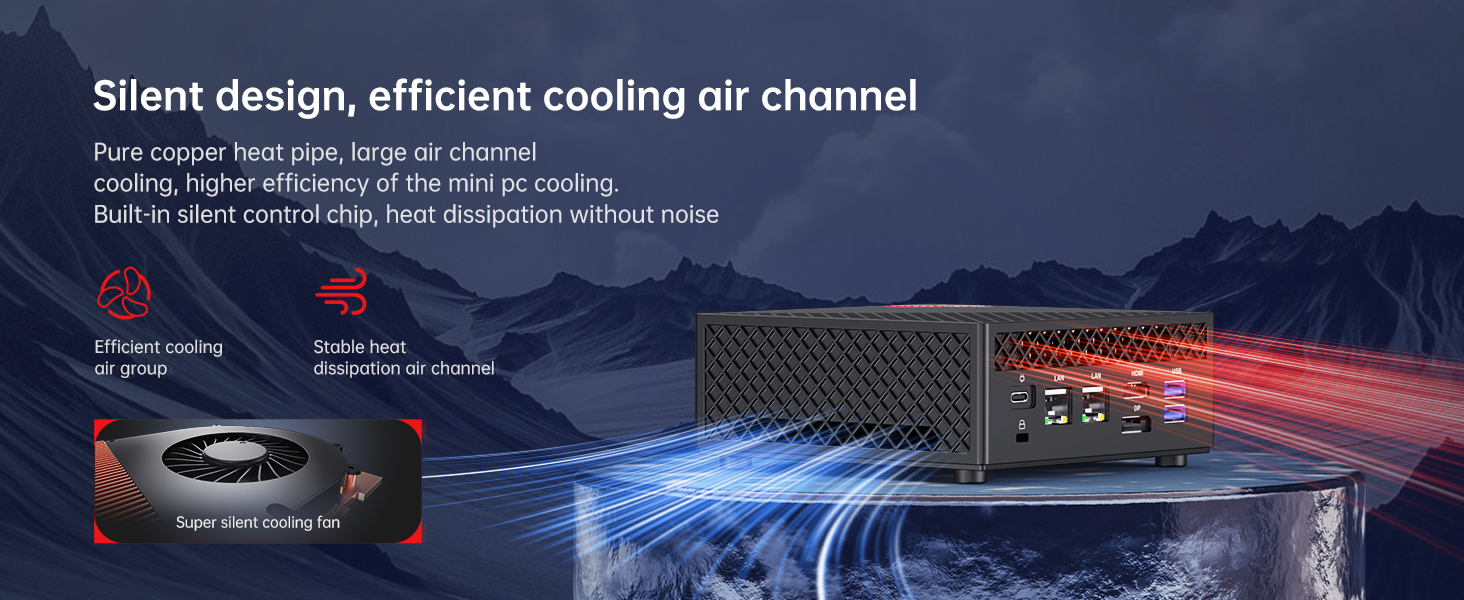
– It is quiet and cool unless you really push it. Even then, it’s not terribly loud.
– Comes with full version of Windows 11 Pro, and no bloatware
The Bad:
– 16GB of RAM is terribly low, considering the rest of the hardware configuration. If you want this to do work with, you will definitely be buying more RAM.
– The power button is terrible. You will constantly press it accidentally, as it is part of the case. On top of that, it is the exact part of the case you will grab to lift or move the computer.
– Only four USB connectors. That is keyboard, mouse, web cam, external hard drive. (oops, ALL FILLED)
– USB-C and audio connectors only on the FRONT of the computer. You could attach a USB hub to the USB-C connector, but that would be ugly. It’s also not too tidy to have your speakers plugged into the front.***
A Buying Tip:
There are currently at least three versions of this computer (AM06 PRO) for sale on Amazon, listed under a couple of different brand names. The cheaper/slower versions are selling for more money. (?!?!??!?) You want the one that is 5600U. It is about a hundred dollars cheaper (currently) than the much slower 4800 and 5500 versions. I see where there are “coupons” for some of them though.
*** There is a USB-C style connector on the BACK. But that connector is only for the power supply.
I ordered the unit with Ryzen 5, 16GB RAM and 512GB NVMe drive.
It’s a small, tidy unit with no glitz or glamour, just a plain black vented case. There is no metal mesh as in every other micro PC I’ve used. What struck me the most was the odd, poorly designed power button. If you pick up the unit there is a very high possibility you will hit the power button and turn off / sleep the PC. This isn’t great, especially for an OS where changing the power button function isn’t a reasonable possibility (Proxmox)
The CPU and RAM are more than adequate for any productivity task. But DiskMark puts the SSD at 460MB/s, this is more on par with a low end SSD, not a NVMe drive. Gaming with modern titles is not a realistic option as this unit has only integrated Radeon graphics. Still this is fine for multi-monitor productivity and streaming video, just not gaming.
I haven’t seen an AMI BIOS in years, but this one has some nice additions: one-time boot override in particular is nice for UEFI.
My biggest complaints are the fan noise and the power button placement. The fan winds up for no reason and it’s not a normal, white-noise “whoosh” sound, more like a warbling motor sound. As this will be a VM host and placed on a shelf, I cannot imagine having to retrieve this computer from the shelf as I will hit the power button every time.
Altogether an excellent value, good hardware and a neat package. The graphics shortcomings are not a concern for anyone in the market for a mini PC. If you’ll be using this device on a desktop, you will be able to see (and avoid) the power button.
[UPDATED 23Apr23]
Ace got back to me promptly about the fan chatter and we decided it best to just order a replacement. The replacement unit’s fan seems to be fine after a few days, so the issue is happily resolved.
Still a great value.
—————–
Overall a great value. I game lightly and generally have older PC games designed to run on older processors. Star War Jedi Fallen Order is the most recent game with the most complex graphics, and it runs fine!
I love the full function USB-C, which accepts a USB-C hub into the power-in socket. So, I can quickly switch my home office setup (wireless keyboard/mouse, monitor, webcam and 65W charger) quickly between my work laptop and this little guy by just moving the USB-C plug between the laptop and this little guy.
I’m unfortunately getting a LOT of chirping from the fan when taxing it during gaming (heavy CPU use), which must have bad bearings. sometimes if I stand the unit up on edge, I can make it stop. I’m going to contact the seller about it.
The location of the power button is also a bit of a pain, as if I lay it down on my desktop (vs mounting behind a monitor), it is VERY easy to bump and send the unit into sleep mode. It would be better to make this a normal recessed button.
This is a good price point for a computer with a 5600U processor, but what really sold me on the unit is the connectivity.
It has a full-function USB C port, and is powered via another USB C.
This means a portable monitor can be run with a single cable connected to it, and the PC can be powered by any generic USB C charger (that can provide 65W). This to me makes it the perfect travel PC.
I had a bad experience traveling overseas with a laptop when the LCD panel died and this rendered the whole laptop I was lugging around useless. This is a much more modular and redundant setup where I am not dependent on access to just one specific LCD, power supply or battery model from one manufacturer. Should any peripherals fail I can pick up a portable monitor, keyboard, USB C power supply or power bank (of sufficient wattage) of any manufacturer in any PC store, and I will have a functional computer again pronto.
Shopping for such a mini PC I was surprised to learn how few of them have a full-function USB C port, and power supply via a USB C is even rarer. However this one has it, which is perfect for my needs.
The mini PC, portable monitor, and compact keyboard combo does not take up any more space in a backpack than a laptop does, but has the modularity advantage. Sure enough, compared to a laptop I now have a few more cables to contend with, but as an added bonus the sitting position can be much more ergonomic than with a laptop that combines a monitor and a keyboard in one part. Honestly the ergonomics aren’t even close.
One nitpick is that of the four USB A on the unit, two are of the slower 2.0 variety. This isn’t a big deal since that’s plenty for a keyboard and mouse and you’ll need two for those devices anyway, but it does force you to think what to plug in where.
Also the fan when spinning at max gets quite loud, however that only happened when I tried gaming, but for office use it is very quiet. Anyway, cooling is a challenge in any small-form computer (laptop or mini PC) so it’s a necessary compromise for the immense benefit of mobility. If anything I’m guessing that with a U-line processor rated for just 25W it’s probably quieter than most.
For storage the computer has one M.2 disk and a free slot for a 2.5 inch SATA SSD. Some would have preferred two M.2 slots, but for me this is preferable as it allows me to reuse one of my 2.5 inch SSDs.
PERFECT OPTION FOR OFF-GRID HOMES
This lil machine does an EXCELLENT job streaming games on both Playstation Plus and Xbox Game Pass – I’m able to run games virtually flawlessly in 1080p (which is the max resolution for both services). Check out my multiple display setup in the photos – touchscreen on the right, wireless display on the left, and if you look close…
…you’ll see I’m running this thing using a POWER BANK!! A large power bank like the one I have (setup to run 65W) will power this mean lil sucker for over 7-8 hours doing web browsing, excel, etc, and so far I’ve been able to stream games at 80% brightness. Using a power bank, portable monitor,and Bluetooth dongle or newer version of the Xbox One controller (with Bluetooth) turns this device into the ULTIMATE GAME STREAMING DEVICE, and a killer option for tiny homes or #vanlife….all thanks to that USB power source.
(PS Just don’t use a Microsoft Xbox One Wireless Adapter cuz the one I got off Amazon two days ago damaged one of only 2 USB 3.0 slots – which is heartbreaking. Just buy one of the newer Xbox One controllers with Bluetooth and you don’t need the dongle).
I wish I was able to spring the extra $100 to have gotten the Ryzen 7, but even with the Ryzen 5 this thing is the REAL DEAL.
Update 5/23:
I worked with the MFG to hit through my issues. They were very responsive and helpful. Having the PC running since I’ve had it and it is very stable, stays cool and runs well. The customer team made all the difference.
This PC is very nice with the exception of 2 flaws. First, Windows is loaded as the Chinese version. This means the when you first turn it on, you have to be able to read Chinese to choose the English language. This can be partially resolved by getting through the installation prompts and then selecting English, however, it is only partial and when you reboot, you will see the initial prompts in Chinese, not English. If you are not familiar with installing Windows from a USB drive, you may want to consider something else.
The second, WORSE issue is that the design of the power button is terrible. It is on the front left of the case and so sensitive that a mere bump resets the computer. This is very dangerous when the PC is installing updates and your computer could become bricked if you bump it. Also it seems like there is some weird ground that sometimes when simply inserting a USB drive makes the computer reboot.
With all that said, it seems to run nice, but now I will have to reinstall Windows to get it to proper English and try to figure out a way to protect the power button from accidental bumps.
Tl;dr highly recommended.
Background: I was looking to replace my existing very large tower PC (c. 2015) with something that was a) more up-to-date and b) less power consuming. To be clear, I have been transitioning to an M1 MacBook Pro and QNAP NAS, and I no longer need to do image and video processing on the PC. So my mid-level nVidia GPU and lots of hard drives were no longer requirements. I was willing to give up the BluRay writer as well. But the Windows PC was still an important part of my multi-level backup strategy. Namely, I keep a copy of all photos, videos and documents on the PC, synchronized using GoodSync from my NAS, and from there I let Backblaze handle cloud backup. (Backblaze won’t sync from network shares.)
The Ace Magician AM06 Pro had a number of appealing features for me. The tiny size was, of course, a big asset. And I do mean tiny. The ability to add a 2.5 inch SSD was mandatory. And the second NIC allowed me to connect my QNAP NAS directly to the PC using 2.5GbE. While this was a step down from my previous 10GbE NIC, that was no longer really necessary. While there are other mini PCs that have a 2.5GbE NIC now, there are very few that have a second NIC, let alone at this price. Oh, and price, which in this case equates very nicely to value. I ordered the mini PC, and my experiment began.
Before I ordered a large SSD, I wanted to see if this was going to work for me. I plugged in the DisplayPort to one of my monitors that had a free DP connection, connected my Logitech mouse and keyboard using their dongle, plugged the 1GbE into my home LAN, and we’re off to the races. Right out of the box, the system came up in seconds, running the Windows 11 OOBE. A few questions later and the system connected to my Microsoft account. Everything seemed fine, so I started with any Windows updates that might be available. There were only a few, so I let that process complete. At this point, I made no changes to the BIOS and no changes to the default Windows configuration.
Now I needed to add Hyper-V support, and I expected to need to change a BIOS setting or two. But no, not necessary, virtualization support was already enabled! I moved a VM over from my other system – with some difficulty that had nothing to do with the mini PC, but I got it sorted out. Then I connected and configured a private network for the 2.5GbE NIC to my QNAP directly, Jumbo frames enabled. No problems there.
I ran a short stress test and I could hear the fan spin up. It’s not a pleasant sound, but I don’t plan on stressing the PC. The next day I came back to continue on the transition, and found the PC had shut down. Oh, no! Very curious, I determined it was after exactly 3 hours of idle time. Hmm, I had disabled sleep. But crafty Microsoft, the power plan still had hibernation set for 180 minutes. Grr. Set to Never now.
A few more days, and it was time to move on to phase 2: add a 4TB SSD. I know the description says that 2TB is supported but I could not think of why the limit (and I have 40+ years in the storage business under my belt). Suddenly a sale price directly from WD appeared, and I proceeded with that. Adding it was a little hairy – the ribbon cable (included) to the motherboard connector looked fragile, and took some care. I knew that at first (before any power applied) I didn’t have it just right and I took my time until I got it. Power up, perfect, no issues, 4TB now available.
I won’t go into great detail about the rest of my configuration other than to say after 10 days, the old tower was powered down, the new AM06 Pro handling everything I needed.
I think you get the point now. My experience has been overwhelmingly great. In the process, my constant power load dropped by more than 60W as reported by my UPS – this was expected. But no review is complete without some “cons”:
The power switch. I can’t tell you how many times I inadvertently touched it and my system shut down. I had to device an approach to make sure this didn’t happen again. My “Server Rack” (photo) keeps me – and more importantly, my cat – from hitting it. I hope Ace Magician does not repeat that design. It looks cool, but asking for trouble. I should drop a star for this, but I won’t 🙂
The power supply. OK, this is not going to cost them a star. When you have such a small PC, the big brick with detachable cord is out of place. I started looking for a tiny USB-C GaN charger to replace it. My first try (a 3 port unit) didn’t go so well as it shut down in 30 seconds every time I powered it up. Someone on the minipc forum tried a bunch of these and found the one that worked: a single USB-C port, Anker Nano II 65W. Same overall rating as the supplied PS. The actual power draw of the PC (in my use case) is more like 20-30W. But this is important: the new GaN charger – added just today – is far more efficient, and switching to it dropped another 20+W from my overall total.
Wi-Fi performance. Meh. I don’t care, I don’t need it, you might. I disabled in Windows.
A second NVMe slot would be “nice to have”.
EDIT: One additional note
The included VESA bracket did not work for me as I have my monitors mounted on arms. If you are considering mounting behind a monitor, you might need a different sort of bracket.
Back to my conclusion: buy it. Incredible value. Seriously.
Addenda: Summary of changes I made from out-of-the-box configuration
1. Disabled hibernation! I blame Windows 11 for this, it was not a default in Win10.
2. One BIOS setting: After a day or so, I could hear the fan spin up sometimes. Poking around in the BIOS, I found fan control was set to “Manual” and there were optional settings. But I figured I would try “Automatic” before getting too geeky, and that’s worked well for me. No more whining!
3. Disabled the Wi-Fi NIC (in Windows).
4. Removed Chinese fonts. No offense, it’s just not one of my languages and I don’t expect to learn it.
This is a review of the Ace Magician AM06 PRO (Ryzen 5 5600U)
Photos included with review:
2 photos show size comparison to common items (a mouse and a 3.5″ hard disk).
2 phots showing available ports.
1 Photo shows location of internal components.
2 photos show how to properly install the SATA drive cable.
The Hardware
This system utilizes an AMD Ryzen 5600U CPU. This CPU packs a surprising punch for a CPU that sips so little energy. It’s amazing what AMD has accomplished here. This CPU has 6 cores and 12 threads. It also includes AMD Radeon graphics.
Others have already commented on the raw performance metrics, so I’ll concentrate on providing general information and a few tips for getting the most out this system.
General System Information
Please see the first two photos that illustrate how compact this system really is.
You will find the usual compliment of ports on the system which include two USB 3 ports, one USB 3 type C port, two USB 2 ports, HDMI, Display Port, and a 3.5 mm audio jack . One unique design feature that AceMagicians have incorporated is the inclusion of not just one, but two Ethernet adapters, including one 2.5 Gbps and one 1 Gbps port. Why might this be helpful? There are several possible scenarios, but for me, I often perform testing using Windows Hyper-V. If I had only one Ethernet adapter, then I would need to share that adapter between the VMs and the primary installation of Windows. My preference is to NOT share the adapter. By having two adapters, I can assign one to my VMs and have a separate adapter available for exclusive use by the main OS. So having this feature available on a mini PC is very welcome.
In addition, it just makes sense to have a 2.5 Gbps Ethernet adapter on modern systems with SSDs. Transferring data between machines with SSDs can easily saturate a 1 Gbps Ethernet so this extra speed is very welcome and matches well with a system containing SSD storage.
I also like the fact that this system has a microphone built-in. That is something typically missing in most mini PCs. It allows for one less having to be plugged into the system.
Another nice touch is the fact that the power connector is a USB-C type connector. That’s really helpful for people like me who are always carrying USB-C power adapters around with them already.
TIP: You may find that some standard off the shelf USB-C power adapters may not work to power this system. In my testing with several different adapters, I found that some of them would power the system on initially, but the system would shut down within a few seconds of being turned on. I found that the latest line of Anker GaN and GaN prime adapters (available here on Amazon) work fine with this system. When purchasing an adapter, make sure that it has a minimum of 65W output power and that it supports 19V (20V) output. I suggest a unit with a single USB-C output because plugging in a second device may momentarily interrupt power to the Mini PC which you obviously do not want to happen while it is running.
What’s really amazing is how all this processing power and all these ports are incorporated into such a small case. As you look through included images, take note of the size of this system in relation to some common items such as a pair of glasses and a computer hard disk.
Initial Setup
The initial setup of the system is very quick and simple. AceMagicians have preinstalled a pristine, clean, Windows 11 Pro installation on this system with no bloatware. I really appreciate this because it makes ensures that you have Windows running at peak efficiency without a bunch of stuff that you will never use slowing the system down.
TIP: After you get the system up and running, make sure that you have an internet connection. I would suggest allowing the system to install all available Windows updates. Once updates are done, open an elevated command prompt and then run these commands:
MD C:Exported_Drivers
pnputil /export-driver * C:Exported_Drivers
This will make a backup copy of all system drivers. I would suggest copying or moving that folder to a thumb drive, external HD, etc. for safekeeping. Then, if you ever perform a fresh installation of Windows, you can simply open Device Manager, right-click on the computer name at the top of the device tree, select “Add drivers”, and point it to your backup copy of the drivers. This will install all the drivers. Note that when the display driver is being installed, the screen may go blank for a few seconds. This is normal.
Expandability
Clearly, AceMagicians has thought about servicability with this system. Simply loosen four phillips type screws on the bottom of the unit and the bottom cover pops right off. There is no need for any prying, wedging, or force of any kind. With the bottom cover removed, access to the SSD and RAM is extremely simple. This system utilizes dual channel DDR4 3200 Mhz SODIMMs and can be expanded to 64 GB, should you wish to do so. Note that the SSD is an NVMe module with a 2280 form factor. Beneath the SSD is the Realtek WiFi module which can be upgraded should you wish to do so. My personal preference is to use an Intel AX210 WiFi 6e module.
TIP: The system comes with ribbon cable to SATA connector to allow you to add a 2.5″ disk in addition to the M.2 SSD that is already installed. However, my system came with no instructions for installation.
Reasons for Purchasing a Mini PC
There are many reasons to consider a Mini PC:
1) The complete system is a very cost-effective solution. This system is very reasonably priced. Why spend a fortune on a computer when you can purchase an entire system in a small box at an affordable price?
2) More than enough speed and power to rapidly accomplish all the tasks that most people perform. A Mini PC is ideal for people who use Word processing, browse the web, perform some mild to mid-level gaming, perform photo and video editing, and much, much more. It is true that if you want to play the latest, cutting-edge, high-end games, you will need more power than a Mini PC will offer, but that is not the case for many individuals.
3) Space savings: It’s almost difficult to explain just how remarkably small these systems are. It’s probably best to look at some of photos that I have included to get a really good sense of the size. Because of the small size, these units will occupy very little space on your desk. Since they include a VESA mount, they can also be directly attached to the back of any monitor with a VESA mount. In that case, they will occupy no desk space!
3) Energy efficient: Because these systems are so energy efficient, they won’t drain your wallet.
4) Expandability: Many persons are surprised at the level of expandability that such a small system can provide. This system comes with 16GB of RAM, which is a generous amount more than sufficient for most tasks. However, if you wish, this system may be expanded up to a whopping 64GB. As for storage, a 512GB NVMe SSD is included with the system. However, even here you have options. A 2.5″ drive can also be added to the system and the NVMe could be swapped for a larger unit if so desired.
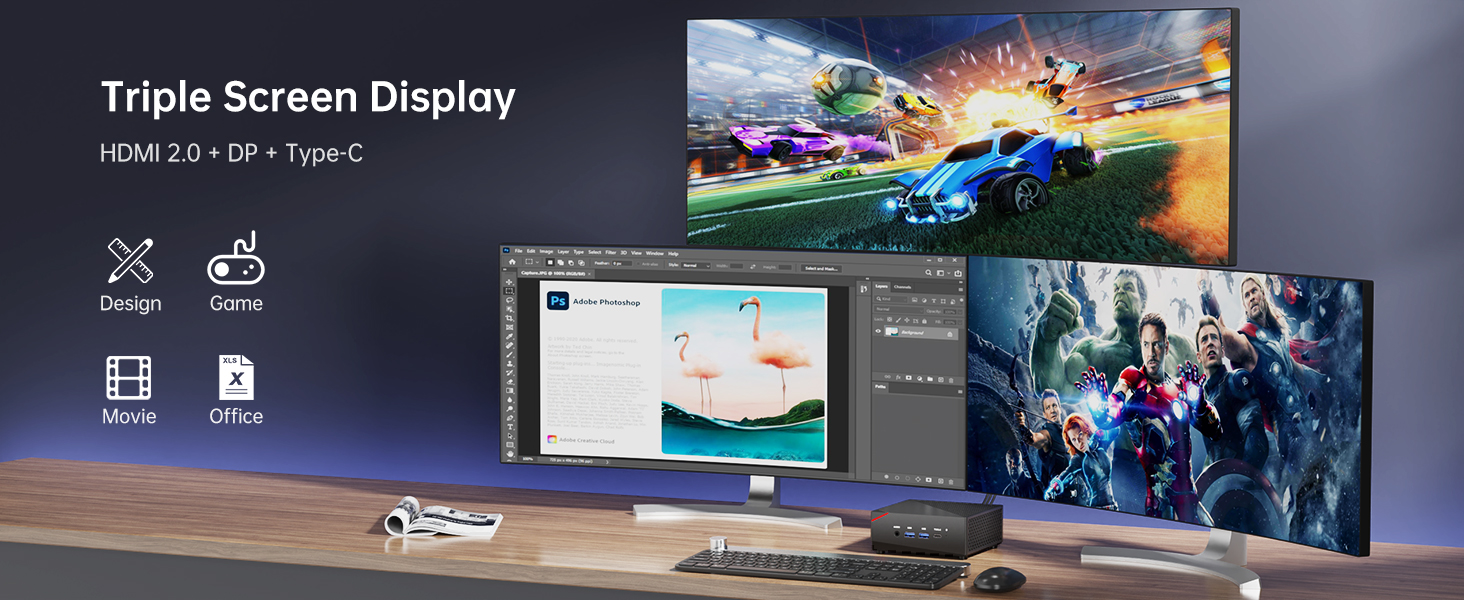
5) External connectivity: This system allows the connection of up to 3 monitors simultaneously using the DisplayPort, HDMI, and USB-C connectors. Naturally, you will also have access to additional devices via the USB ports. Even network connections are plentiful with WiFi and Bluetooth, as well as both a 1Gbps Ethernet port AND a 2.5Gbps Ethernet port.
Summary
I can whole-heartedly recommend this system. My initial thinking was that I could use it for some offline data storage and some very light tasks, but after realizing how much better the performance was compared to what I expected, I decided to promote this system to a more important role in my digital life.
If you are considering a Mini PC, I think that you will be pleasantly surprised by the performance and value that this little beauty provides.
So I read the negative reviews, and the most common complaints are slow CPU, WIFI5, and runs hot. I call BS on all three.
If you are a gamer who requires high FPS, no this is not the PC for you. It’s not advertised as such.
I ran speedtest (speedtest.net) and get up to 145 Mbps, which is plenty good. And if I had WIFI6 the speed would not be better because that’s all Comcast gives me anyway. Never had a lag with WIFI even at 50 Mbps with an older PC.
Runs hot? No way. A little warm maybe, but that’s all. My house is at 67 degrees right now (45 degrees outside at the moment). I can imagine this PC getting warm in a house without air-conditioning in the summer. But you’ll have that problem with any mini-PC.
This is a great deal and more than enough computer for MOST people.
I purchased this to run triple monitor (2x1440p, 1x 1080p) and to watch youtube, netflix, etc. Streaming one at a time is fine, however if you have other tabs opened and that too is playing a video, then it begins to stutter. Upgraded to 32GB of RAM, however the issue is with the APU.
Pros:
Small and low energy
Can output 3 displays
Cons:
Can get loud under load
APU is not that strong
Definitely not for gaming
Ended up returning it and building an ASROCK deskmini. Much better experience.
This mini computer comes with all the accessories ready to be used:
– The mini computer
– A USB-C wall charger (65W)
– US power cable (Mickey Mouse/C5 connector)
– SATA HDD cable
– VESA mount and scres
It comes with a Windows 11 Pro license installed in the UEFI/BIOS and I was able to downgrade to Windows 10 Pro without any issues.
Some reviews mention that the SSD is SATA, but in my case the M2 SSD is NVME with respectable performance (See pic)
WiFi performance seems good, but I use this machine as a virtual machine host, so I don’t actually use the wireless interface.
Bluetooth also works without issue.
It might be a bit hard to find settings in the UEFI since it is completely unlocked and there are many options that you don’t see in locked down models.
The fan is pretty silent unless you are running a stress test or something like that.
On the inside, the memory, NVME and WiFi adapter are upgradeable and you can add a SATA drive with the provided accesories. The provided memory is 2x8G CL22 DDR4-3200, the NVME says “FORESEE FSB0C512G-35C6600” and the WiFi adapter is an RTL8821CE.
So far I’m pretty happy with this device and I would consider it both as a daily driver and for media center duties.
The only issue I’ve had with this minicomputer is that the front USB ports lack ESD protection and plugging or unplugging devices while it is on might cause a shutdown. This has been documented in the manufacturers forum and I assume newer revisions will have this covered. The back ports don’t seem to have this issue and for my use case I use a USB-C hub for my devices so I don’t really suffer from this.
I normally build my own PCs when I need one, but I could not come close to the price of this one, even by reusing an old case and power supply. This little guy is a great deal. It has replaced a machine that I use as a media server and for office-type work and light graphics editing. That old computer was in a HTPC case, built for quiet cooling, and it was huge. This little guy has freed up a whole shelf on my media center, and with the addition of a SSD, it can do everything my old computer was doing, only faster. It came with a small SATA cable in the box (be careful you don’t lose it – it’s small and just kind of loose in there), and though there are no instructions on how to do it, it was easy enough to install. My only quibble is that there is no USB3 port on the back. I have a USB3 cable that runs to a docking port on my desk, and I have to leave it always plugged it into the front, which detracts from the otherwise clean look. As a slight compensation, the power button is pretty cool (it’s built into the corner of the case, and has an easy-on-the-eye red glow when the PC is on). So far, I am very happy with this purchase.
I had it for two days, and so far so good, except for the window 11 reinstallations. The window was slightly acting up (lagging and ad.doubleclick B/S) from the first boot, also would not allow me to surf the net. Pretty sure it was my internet. clean window installation would be a plus and specs on this Mini ( Ryzen 5 5600u), 16 GB DDR4-3200MHZ, an HDMI and Display Port, Type C, ETC. Not bad for a Mid 300 PC, It does run smoothly, if you are just in for streaming or some office work (casual PC use) this would be the one. You can save 700 plus. In case of clean window installation, you need to get drivers updated from the AMD site for missing drivers.
-After one month still great
comparing it to my Alienware Aurora 7 10 12 13, Pretty much No differnce on casual use.
I’m running some recording software (pro-tools), but no intense gaming. The 16 gigs of RAM and Ryzen 5 processor seems to be plenty fast for what I am using it for. I’ve been using it for about 4 days and the only issue that I have is that if I plug in a USB device (flash drive or passport) while the unit is booted, it will re-boot as soon as anything touches the USB port. Not sure if that is an issue with my unit itself or if it is an anomaly with the product in general. Other than that, it seems like a no brainer for the $300 that I paid for it. It got me out of a pinch when the motherboard on my 14 month old thinkpad went bad and wouldn’t boot up.
I was looking for a micro PC with enough power and expandability to run the VMWare vSphere Hypervisor. Previous micro PC’s have had limitations such as limited un-expandable RAM (16GB), low CPU cores (4) and the RealTek NIC’s limited to running vSphere 6.7 with a custom image.
This mini PC solves all of those problems. The 2.5 Gbps NIC is an Intel I225-V which is compatible with standard vSphere distributions, including the latest 8.0.0. The 1 Gbps NIC is a RealTek NIC and is not seen in VMWare standard installations. For my intended use case, I just needed a single NIC so this worked well for me.
The memory expandability is fantastic. It comes with 2x8GB DDR4 3200 SODIMMs, and I expanded it to 64GB via 2x32GB very easily. There is an thin cable you can attach to the motherboard to connect a SATA drive in the base. My only complaint is there is no documentation on how to install this thin cable and it seems relatively flimsy and weak. I am pretty certain I broke a tab while trying to figure it out. Some hot glue fixed the issue and made it a little more stable in my installation.
The use of a standard 19 USB-C PD power connector is a nice touch -one less proprietary power connector to deal with.
I used it for doing email, streaming, browsing and general use. It is easy to set up and use. The location USB ports on front and back are verry convenient. Having an HDMI port and a Display port provides flexibility. If one pushes the power connector into the provided slot, it locks in place and prevents the power cable from being pulled out inadvertently. Adding an internal drive is tricky as one needs to put a ribbon cable in a slot and lock it down. The drive then needs to be pushed into four tabs meant to hold the drive. If not done properly, the drive will come loose when the case is put back on.