Felle Fatale masterpiece... Great movie – all the actors are on great form.
Edward J is the outstanding actor in my opinion. Without giving too much away, it is interesting to see how his view of his work colleague slowly changes…
Classic Film Noi Fascinating story that hooks you in right from the start even though you don’t want it to. It is actually quite uncomfortable to watch Fred MacMurray’s character getting in up to his neck with a devious plot assisted by Barbara Stanwyck’s femme fatale. Brilliant film noir from the classic period.
Inventor of the film noir look.... This is truly one of the first film noir’s to come out of Hollywood after the war, but this treasure came out in 1944. Still a crisp and tense tale of greedy people thinking they can get away with murder is timeless. Fred MacMurray… not the first choice or the most obvious, but he turns in the best performance of his entire career in this one. Much has been said about Barbara Stanwyck’s much hated cheap blonde wig but I saw it as a young man and thought nothing about it until I starting reading these things about it. Still doesn’t bother me at all. Edward G. is perfectly cast as the brainy hero-guy who is also MacMurray’s workaholic boss.
I must say I have grown to appreciate Billy Wilders films much more in the last few years with the release of his works being released on blu ray format. His witty/satirist writing still holds up decades later and should be studied by writing students. The cinematography is in glorious B&W and uses for the most part real L.A. locations which I have always found better anyway. I always hated that well-lit stage set look that early films seem to have.
This is a MUST for any serious film buff or even the average film goer who likes well crafted suspense. Includes a very good commentary.
Good Blu-Ray Presentation for the Early Billy Wilder 'Noire' with Worthwhile Extras and a Decent Steelbook Optio This is one of the earlier films directed by the marvellous Billy Wilder and much, much ‘darker’ than his later, perhaps more popular/well known efforts such as ‘Some Like It Hot’ or the superb ‘The Apartment’.
It is quite clearly of the film noire genre, made in a style which he maintained for his next movie (‘The Lost Weekend’) before ‘lightening up’ a tad with later productions such as ‘Sunset Boulevard’ and ‘Stalag 17’.
Not having seen this film properly before, I got it on Blu-ray in a steelbook (sub-10, I was lucky !) and, considering the age of the film stock, was impressed with the quality of the restoration.
If somehow this film has passed you by, the Amazon synopsis for it on this webpage describes things very well.
Being such a pure noire, the plot and way things happen is quite stark and cold and the ending (which is largely known due to the flashback nature of the presentation) is about as grim as could be for such an old film; overall, this film is quite a tough, unamusing, watch – even without any of the blood/gore etc we get nowadays.
For me, the blemish-free image has a good contrast and is pleasingly sharp; the DTS-HD MA mono soundtrack is also nice and clear but obviously not at all ‘active’.
The disc extras are worthwhile and there is also a nice accompanying booklet – both features which are established Eureka ! / Masters of Cinema specialities; the steelbook is also very smart (despite the slightly inappropriate pink/rose colour scheme !), with artwork both inside and out.
I’ve attached photos of the steelbook exterior, interior and contents as Amazon don’t properly show/omit them.
Aside from being able to get this in a cheaper ‘normal’ box, you might be interested to know that Universal have a quite recent US edition of this film on Blu-ray which is region-free, offers different extras and is available in 2 guises, here are the Amazon links (and a link to a comparison review with screencaps is in the Amazon discussion section for this Blu-ray; it’s entitled ‘Comparison Review with Screencaps’ and dated 21 Aug 16).:
Double Indemnity [Blu-ray] [1944] [US Import ]
Double Indemnity [Blu-ray] [1944] [US Import ]
If the ‘noire’ genre is to your taste then this early example should be right up your street; if you already know of the film or like Billy Wilder productions then this Blu-ray is a good way to enjoy it !
Terrific film, poor audio commentary Little needs to be said about Double Indemnity. It’s a terrific film with, for my money, a stunning performance from Barbara Stanwyck.
If, like me, you’re more interested in these reviews for what they have to say about the package, here’s a few thoughts. You get a decent documentary (around 30 minutes), a trailer, the radio adaptation, a booklet, and an audio commentary. Personally I was hugely frustrated with the commentary. Whilst the two speakers are doubtless very knowledgable, they make what I consider to be the cardinal sin of doing an audio commentary and don’t actually provide commentary on the scenes as they unfold, preferring instead to give general thoughts about film noir and the film in its historic context. So many iconic, wonderful moments go by with the speakers wittering on about something tangential. That’s not to say that what they’re saying isn’t interesting, it’s just that it has no place in an audio commentary, in my view. A pet peeve of mine, and others may feel differently, but for me I wanted to hear them discuss the key moments at least, and the story much more. As it is I’m sorry to say much of the running time is spent with Lem Dobbs reminiscing about the time he spent with Wilder. Sorry Mr Dobbs, but who the heck cares?
PURE CLASS 1940s CLASS ACT. A movie that springs from the classic period that gave us such dramatic gems as Casablanca, Citizen Kane, The Third Man etc. Movies which will live forever for they cannot be bettered. They stand together in a class head and shoulders above any ‘modern’ drama. This exceptional drama of the ‘perfect murder’ gone wrong (don’t they always!) is mesmerising throughout. It SHOULD have got 1944s best movie Oscar, instead of the Bing Crosby movie.
If you cannot see yourself being enthralled by an old b & w movie GIVE IT A CHANCE – its a rewarding experience.
COLUMBO would have loved to tackle this case. It’s a shame he did not get the chance. UNMISSABLE!
SUPERBLY presented on this Universal DVD, THANKFULLY retaining its original film format and NOT thoughtlessly cropped by 25% just to accommodate a 16:9 TV. It’s a shame more 4:3 movies are not treated with the same respect.
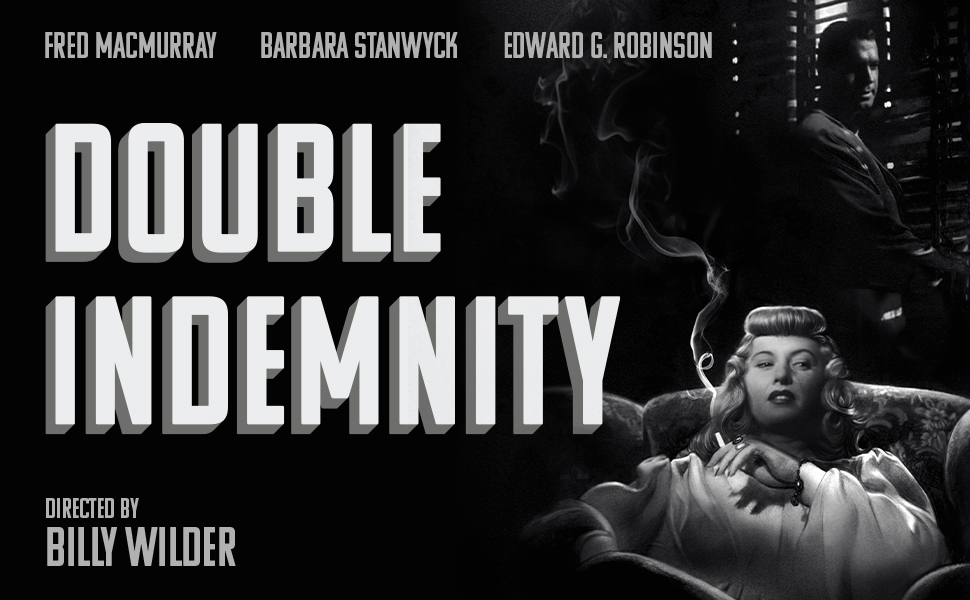
DOUBLE INDEMNITY [1944] [70th Anniversary Limited Edition] [Blu-ray + DIGITAL HD with UltraViolet] [US Import] DOUBLE INDEMNITY [1944] [70th Anniversary Limited Edition] [Blu-ray + DIGITAL HD with UltraViolet] [US Release] An American Movie Classic! From The Moment They Met It Was Murder!
Fred MacMurray and Barbara Stanwyck star in the gripping film noir classic, `Double Indemnity’ directed by Academy Award winner Billy Wilder. A calculating wife [Barbara Stanwyck] encourages her wealthy husband to sign a double indemnity policy proposed by smitten insurance agent Walter Neff [Fred MacMurray]. As the would-be lovers plot the unsuspecting husband’s murder, they are pursued by a suspicious claims manager [Edward G. Robinson]. It’s a race against time to get away with the perfect crime in this suspenseful masterpiece that was nominated for 7 Academy Awards including Best Picture. Narrated by Fred MacMurray.
FILM FACT: 17th Academy Award Nominations: Billy Wilder [Best Director]; Barbara Stanwyck [Best Actress]; Billy Wilder and Raymond Chandler [Best Writing and Screenplay]; John F. Seitz [Best Cinematography in Black-and-White]; Mikls Rzsa [Best Music, Scoring of a Dramatic or Comedy Picture] and Loren Ryder [Best Sound and Recording]
Cast: Fred MacMurray, Barbara Stanwyck, Edward G. Robinson, Porter Hall, Jean Heather, Tom Powers, Byron Barr, Richard Gaines, Fortunio Bonanova, John Philliber and Raymond Chandler (cameo)
Director: Billy Wilder
Producers: Buddy DeSylva and Joseph Sistrom
Screenplay: Billy Wilder and Raymond Chandler
Composer: Mikls Rzsa
Cinematography: John F. Seitz
Video Resolution: 1080p [Black-and-White]
Aspect Ratio: 1.33:1
Audio: 2.0 DTS-HD Master Audio Mono and Spanish: 2.0 DTS Digital Surround Audio Mono
Subtitles: English SDH, Spanish and French
Running Time: 108 minutes
Region: All Regions
Number of discs: 1
Studio: Universal Studios
Andrew’s Blu-ray Review: Fred MacMurray’s sharp-as-a-knife voiceover, which barely lets up from start to finish, is an unremitting delight in the Hollywood “film noir” classic `Double Indemnity.’ `Double Indemnity’ [1944] was directed by Billy Wilder, co-written by Wilder and Raymond Chandler, and produced by Buddy DeSylva and Joseph Sistrom. The film stars Fred MacMurray, Barbara Stanwyck and Edward G Robinson. The “film noir” is the most intoxicating of Hollywood cocktails, and none is more potent than `Double Indemnity.’ It breaks the rules of filmmaking with breath-taking confidence and is all the more satisfying for it. For instance, directors usually endeavour to “show but not tell”, yet Fred MacMurray’s sharp-as-a-knife voiceover, which barely lets up from start to finish, is an unremitting awesome delight.
Walter Neff [Fred MacMurray] is the top salesman at his Los Angeles insurance company, and his close friend, an expert claims investigator named Barton Keyes [Edward G Robinson], wants him to work in his department. But although the two have a bantering, easy-going friendship, Walter Neff decides to stay with his sales job. One day, while making a routine call on an auto insurance client, he meets the client’s sexy blonde wife, Phyllis Dietrichson [Barbara Stanwyck]. Although she appears to be subtly seducing him, she coldly rebuffs his advances and sends him on his way. Soon after, however, she invites him to come by her house and discuss additional coverage for her husband. When he arrives, he finds Phyllis Dietrichson alone with no husband and no maid. Their mutual attraction quickly graduates to undisguised lust and before Neff knows it, Phyllis Dietrichson convinces him to sell her additional accident insurance for her husband (without the man’s knowledge). It’s just the first step in their mutual plan to murder Phyllis Dietrichson’ husband and collect on a double indemnity clause in the insurance contract.
Cold-blooded, brutal, highly stylised, and informed with a black sense of humour, `Double Indemnity’ is one of the high points of 1940s filmmaking and a prime example of a genre and style that remains highly influential in its look, attitude and storyline. Critics have argued whether or not this film can be considered the first “film noir” thriller, but it undoubtedly set the pattern for that distinctive post-war genre: a shadowy, night-time urban world of deception and betrayal usually distinguished by its “hard-boiled” dialogue, corrupt characters and the obligatory femme fatale who preys on the primal urges of an ordinary Joe.
Edward G. Robinson, best known as the megalomaniac gangster in `Little Caesar’ [1930], was no stranger to playing characters on the wrong side of the law, but in `Double Indemnity’ he plays the lethal lovers’ nemesis, Barton Keyes, a shrewd investigator who can smell a phony insurance claim a mile away. The film places the three leads in an unconventional love triangle especially with Walter Neff lights Barton Keyes’ smokes more often and more affectionately than he does Phyllis Dietrichson’ cigarettes, and he tells the other man “I love you” at least as much. At the end, it’s Barton Keyes who kneels by the fallen Neff, in what Bernard F. Dick, in his 1980 book “Billy Wilder” recalls “one of the most powerful images of male love ever portrayed on the screen: a pieta in the form of a surrogate father’s lighting the cigarette of his dying son.” It’s the most tender moment in an otherwise hard-as-steel story.
Although Barbara Stanwyck has played heavies before, she had never been cast as an out-and-out murderess. She was afraid of the role, she told Wilder. “Well, are you a mouse or an actress?” he replied and just the sort of remark to get the desired reaction from Barbara Stanwyck. Never one to back down from an acting challenge, she took the part and turned it into one of her best. Known for her easy-going, non-temperamental, and thoroughly professional approach to acting, Barbara Stanwyck worked well with Billy Wilder. “She is as good an actress as I have ever worked with,” he later said, “Very meticulous about her work. We rehearsed the way I usually do, Hard! There were no retakes.” Indeed, Barbara Stanwyck was beloved by many directors, actors and technicians in the business. Probably the only negative comment to emerge about her performance in `Double Indemnity’ has nothing to do with her acting; some critics complained about the fake blonde wig she was required to wear as Phyllis. True, it does add to the character’s flashy nature and insincere manner, but as one Paramount executive said after viewing early rushes, “We hire Barbara Stanwyck and here we get George Washington.”
Casting Fred MacMurray as Walter Neff wasn’t so easy. At first Billy Wilder tried to interest Alan Ladd, then George Raft. After the director told George Raft the story, the actor asked him, “Where’s the lapel?” Lapel? George Raft explained he was waiting for the moment when Neff would flip over his lapel and reveal the police or FBI badge underneath, thus identifying himself as the film’s true hero in the final reel and George Raft replied, “No deal.” Then Billy Wilder came up with the idea of using Fred MacMurray, who had a much more genial screen image at the time. “I’m a saxophone player; I do little comedies with Carole Lombard,” Fred MacMurray argued. Billy Wilder eventually convinced the actor to take a bold step. Years later, Fred MacMurray would look back on Walter Neff as his all-time favourite film role.
The narrative romps along with the help by Mikls Rzsa’s urgent, jangling brilliant score and a screenplay by Wilder and Raymond Chandler simply zings along. Billy Wilder wrote the script with Raymond Chandler, and it was a match made in hell. For a start Billy Wilder took great offence against Raymond Chandler’s pipe; Raymond Chandler didn’t like Billy Wilder’s baseball cap and riding crop, and much besides, and later described their collaboration as “an agonising experience [which] has probably shortened my life,” but despite this, both of these characters eventually produced a great “film noir” classic.
But finally, in `Double Indemnity’ at precisely 1:24:07 when Barbra Stanwyck pulls outside the supermarket to meet Fred MacMurray, when another car pulls up directly behind Barbra Stanwyck’s car and there is a mysterious male driver watches intensely as Ms. Stanwyck walks into the supermarket, well with both audio commentary whether it is part of the plot of `Double Indemnity’ as nothing is explained or elaborated into whether this person was a private detective was hired to keep an eye on the movements of Ms. Stanwyck and Mr. MacMurray to eventually catching them out of their dirty deed of plotting together with the murder of her husband and making fatal mistakes and again this has really puzzled me greatly while I reviewed this Blu-ray disc and I wish someone would put me out of my misery and try to explain this very confusing sub plot of this film?
Blu-ray Video Quality – Universal Studio brings us this superb brilliant Blu-ray with a 1.33:1 aspect ratio with an awesome stunning 1080p encoded image and he elements appear to be in very good shape, with no major damage.. `Double Indemnity’ is one of the most exquisitely photographed “film noirs” of all time and Universal Studio has done a remarkable job with the film’s Blu-ray debut by upgrading the picture image while still remaining faithful to the cinematographer John F. Seitz’s work. The transfer has a pristine crisp image and features fine beautiful textures and details, as well as excellent contrast and gets a brilliant 5 star rating.
Blu-ray Audio Quality – Universal Studio has once again brought you an awesome English 2.0 DTS-HD Master Audio plus a Spanish 2.0 DTS Digital Surround Audio Mono. Subtitles in English SDH, Spanish and French. The audio transfer is also stellar and features ultra clean dialogue, balanced sounds and an immersive and revolutionary score by Mikls Rzsa musical score, which his boss at Paramount hated but Billy Wilder loved, supplies discordant and foreboding notes from the film’s very opening.
Blu-ray Special features and Extras:
Digitally Re-mastered and Fully Restored from a High Resolution 35mm Film Element.
Universal Archive 1944 `Double Indemnity’ Art and Photography: Includes 1 Theatrical Poster Reproduction; 3 U.S. Lobby Card Reproductions and 1 Alternative Ending Gas Chamber Still.
Introduction by Turner Classic Movie host and Film Historian Robert Osborne [480i] [4:3] [2:29] Here we get some insightful information about this classic Billy Wilder “film noir.” Robert Osborne tells us that things would have been so oh different, if things had not come together like it did. One big problem is the story itself that was written by James M. Kain that was about adultery characters who were involved in a conspiring murder insurance scam and the storyline stepped over way too many lines to win approval from the Hollywood Production Code Office [Hays Code], which ruled film content and took eight years to get the stamp of approval. We also hear how Billy Wilder was able to convince the stars to take a leap of faith to appear in `Double Indemnity,’ but before that, other well-known stars turned down the parts in this classic “film noir.” But the three main actors of this film agreed that it was their best ever film they have appeared in.
Feature Documentary: Shadows of Suspense [2006] [480i] [4:3] [37:55] Plunge into the world of 1940s Hollywood and a revealing look at a film masterpiece. To join us on this journey we have the following contributors to delve into this brilliant “film noir” and they are Phil Cousineau [Author of “Once and Future Myths”]; Eddie Muller [Author of “Dark City: The Lost World of Film Noir]; William Friedkin [Director of `The Exorcist’]; Elizabeth Ward [Editor of “Film Noir Encyclopaedia”]; Dr. Drew Casper [Professor of USC School of Cinema-Television]; Paul Kerr [Film Critic and TV Producer]; Alain Silver [Editor of “Film Noir Reader Series”]; James Ellroy [Author of “L.A. Confidential”]; Paul Duncan [Author of “Noir Fiction”]; Richard Schickel [Time Magazine Film Critic]; Vivian Sobchack [Professor of Film, Television and Digital media, UCLA]; Kim Newman [Author and Film Critic]; James Ursin [Author of “The Noir Style”]; Caleb Deschanel A.S.C. [Cinematographer of `The Natural’] and Owen Roizam A.S.C. [Cinematographer of `The Exorcist’]. What is so great about this fascinating documentary about how “film noir” came about because of a sea change in the American Society, via the 2nd World War and Pulp Fiction. We also hear interesting information how `Double Indemnity’ evolved, especially with the director Billy Wilder. But of course it all started with the author James M. Kain who happened attended a murder trial with a wife taking out an Accident Insurance on her husband and captured the author’s imagination, which he also used as the basic plot for his novel “The Postman Always Rings Twice.” Even though the script for `Double Indemnity’ was sent to all of the Hollywood Studios, and it languid for years until it was taken up by Paramount Studios.
One myth on why Billy Wilder was interested in making `Double Indemnity’ is because his secretary locked herself in the toilet until she had read it all and according to the legend and that is one reason why Billy Wilder wanted to direct the film, but again it was just a myth. Even though Billy Wilder had been a prolific screenwriter, he still liked to collaborate with other people, and that is why he eventually teamed up with Raymond Chandler, but despite hating each other, but they eventually came up with a totally witty script for `Double Indemnity,’ even though Raymond Chandler had never worked in Hollywood before. What is also fascinating about this documentary is the process on how `Double Indemnity’ finally came to the silver screen and Billy Wilder’s endeavour to get the actors to appear in the film, and everyone was so surprised why Fred MacMurray was chosen, but now everyone realises that Billy Wilder knew the main actors would be so ideal for the film. As an interesting anecdote, we hear about Billy Wilder’s attitude, especially having Barbara Stanwyck being made to buy a cheap blonde wig that made her look sleazy. Another brilliant anecdote we hear is when at the 17th Academy Award Ceremony, when `Going My Way’ and `Double Indemnity’ were both nominated, but when Leo McCarey went up to accept his award for Best Director, Billy Wilder put out his foot in the aisle and tripped up Leo McCarey, who fell flat on his face and Billy Wilder had a big grin on his face. But people now say that they cannot understand why `Double Indemnity’ didn’t get an Oscar. But I think Eddie Muller summed up this interesting documentary, when he says, “this film `Double Indemnity’ sums it up, what is “film noir” about.” Well Billy Wilder and Raymond Chandler wrote it, and in a nut shell they said, “I did it for money.” But finally Leo McCarey says that Fred MacMurray really summed it all up when he says at the end of the film, “I did it for the money, I didn’t get the money and I didn’t get the woman,” pretty isn’t it, that’s it, enough said, that’s film noir.”
Double Indemnity (1973) TV Movie [480i] [4:3] [74 minutes] A scheming wife lures an insurance investigator into helping murder her husband and then declare it an accident. The investigator’s boss, not knowing his man is involved in it, suspect’s murder and sets out to prove it. As a final comeuppance to this ghastly remake when the TV movie was broadcast on American Television, Dr. Drew Casper was at Barbra Stanwyck’s home, with both of them watching this remake, and out of the blue Billy Wilder telephone Barbra Stanwyck after the airing and said quite simply, “missy, they didn’t get it right” and suddenly Billy Wilder put the receiver down. Well that about sums up about this 1973 TV Movie, they certainly lost the plot and it should never have been attempted in making this ghastly made for TV Movie, as people should never attempt to think they can improve on the original Billy Wilder Classic Hollywood “Film Noir” 1944 `Double Indemnity,’ I rest my case.
Theatrical Trailer: The Original Theatrical Trailer for `Double Indemnity’ [1944] [480i] [4:3] [2:14] “Paramount’s shocking . . . suspense-filled masterpiece of love . . . and murder!” Although it is a brilliant tour-de-force Trailer, but what is a total shame the Universal Studios could not of found a better pristine print, as it is of really bad quality, especially compared to the stunning 1080p encoded print image of the film.
Audio Commentary with Film Historian Richard Schickel: Here we have a totally brilliant dedicated audio commentary by Richard Schickel, who is so totally passionate about this classic “film noir,” that is a must hear audio commentary. But what we get to hear is some totally fascinating behind-the-scene informative information about how `Double Indemnity’ evolved to end up on the silver screen. You hear his interesting slant on the author James M. Kain, and how originally he was editorial writer under the influence of Walter Whitman of the New York World and also becoming the managing Editor of the New Yorker magazine. Eventually James M. Kain headed for Hollywood about the time of his success with the novel “The Postman Always Rings Twice,” to finally write screenplays, which he was not very successful. Richard Schickel also gives us some really interesting facts about how the “film noir” came about especially via French paperbacks series called “series noir,” meaning “black novels” and were eventually re-printed in America and eventually French film critics started to calling films based on the “series noir” paperbacks that were turned into films, and they then started to call them “film noir” and eventually crossed over to America in early fifties and early sixties. Richard Schickel really likes to point out the brilliant dialogue between Fred MacMurray and Barbra Stanwyck at their first meeting, is pure Chandler/Wilder invention, especially their immortal dialogue where the two actors talk about speed limits and other sexual innuendoes. Edward G. Robinson is highly praised by Richard Schickel, especially pointing out that the veteran actor originally came into films via gangster Films, and especially the genius and expansion of his part in the film and his relationship with the character Walter Neff and their “bromance.” Richard Schickel heaps great praise on Mikls Rzsa edgy erotic musical score, which adds great atmosphere to the film. Another fascinating information we get to hear about is a superb invention by Billy Wilder at around 57:07 minutes of the film, with Fred MacMurray and Barbra Stanwyck in the vehicle late at night, where they cannot start the car, and Billy Wilder was shooting the scene on the sound stage and broke off for lunch, went to his car to go off the lot and his car wouldn’t start and says, “oh what a great thing and they are about to make their getaway,” so he left his car and ran back to the sound stage in the hope that had not dismantled the mock-up vehicle created for the specific scene and said, “hold it, hold it, hold it” and asked to redo the scene again where the car could not start, but Fred MacMurray commented that no one would believe the scene that Billy Wilder wanted the audience to see and was proved right all along. The critical reception to this film was quite respectful, but a little bit puzzled and a little bit uncommitted to the visual and verbal mannerism that Billy Wilder had exploited so brilliantly with this film, but at the time was not huge or popular and Richard Schickel didn’t think the studio lost any money on the film or neither was it a gigantic success at the box office, but rightly it won a number of Academy Awards Nominations.
But what was also interesting is that the great director Alfred Hitchcock sent a glowing telegram to Billy Wilder after the opening Night Premiere. Also James M. Kain was at the back of the cinema and after the film finished and saw Billy Wilder coming towards him and suddenly hugged the director and said, “you so improved my story and I was writing too hasterly.” But Richard Schickel points out that although at great expense the alternative ending was filmed, where Fred MacMurray is executed in the gas chamber, but in the end Billy Wilder’s instinct not to put add that scene of the gas chamber and instead ended the film where the two “bromance” characters are in close congress, as Fred MacMurray is at the end of his life, was the perfect final solution to the plot of the film. So all in all the audio commentary by Richard Schickel is totally brilliant and so full of fascinating information of this Classic Hollywood “film noir” and it will be a great loss if you do not give this your fullest attention, as it is THE most interesting and fascinating audio commentary I have heard in a very long time and I give this a definite 5 star rating and Richard Schickel should get some kind of award for his in-depth and analysis knowledge of this film, as you will never get bored with such an intelligent voice of this brilliant narrator. So all you aficionado film fans out there, enjoy!
Audio Commentary with Film Historian/Screenwriter Lem Dobbs and UK Film Historian scholar Nick Redman: With the start of this interesting audio commentary, you hear Nick Redman introducing Lem Dobbs and Nick Redman starts saying he was the screenwriter of the `Limey,’ `Dark City’ and `The Score,’ but Lem Dobbs has to correct Nick Redman in saying, “that I was only the co-writer of some of those films,” so sadly Nick Redman has not got off to a good start and should research his facts more professionally. But of course the conversation starts off with asking what is “film noir” and Lem Dobbs [who I really liked and especially his immense knowledge on the film history of this film], but Lem Dobbs informs us that this is a big question and especially to date there have been at least 50 books released on this subject of “film noir” and `Double Indemnity’ was one of the earliest film in this genre. Lem Dobbs points out a very interesting information of this film and its label “film noir” is that putting this film in perspective, that many of the well-known Hollywood actors we associate with this type of film were not on the radar yet and mentions Kirk Douglas, Burt Lancaster and Robert Mitchum, plus there has been a lot of discussion on how Billy Wilder put Fred MacMurray as the lead in the film, who previously use to be this light weight kinda comic romantic actor in minor films by and large make him into a venal character like this, well one answer to that questions who else was there and maybe an actor like Robert Ryan could have been the lead character in the film, but Lem Dobbs states that Fred MacMurray gave the performance of his career with this film. Another aspect of what I like about Lem Dobbs, is how he talks very intimately fascination about the director Billy Wilder and how he became very good friends to Lem Dobbs and was in great awe of Billy Wilder and also gives us lots of funny anecdotes about different things that happened between the two of them both over the years until Billy Wilder passed away.
So to sum up with this particular audio commentary, which is so much different from the Richard Schickel audio commentary, who gave a much more concentrated comment on `Double Indemnity’ and its different complexities? But with the Lem Dobbs and Nick Redman audio commentary, it is more about Billy Wilder and the process of making the film `Double Indemnity,’ plus I also liked the way Lem Dobbs gave great insight into what made Billy Wilder ticked and also his great friendship they had. But to be honest, I cannot see why Nick Redman was allowed to be in the same room doing the audio commentary, as he hardly puts any effort into the recording, as he lets Lem Dobbs do all the talking and it would have been far superior if Lem Dobbs was allowed to be there on his own, as he was the most engaging person out of them the two of them.
Finally, In a nutshell, what makes Billy Wilder’s film THE number one “film noir” is that it set the trend; perfected the formula. `Double Indemnity’ was one of the first films to weave all those characteristics together. Billy Wilder was one of the European directors that the “film noir” is so often associated with and he would, like fellow migr Fritz Lang, produce additional films in the same genre. `Double Indemnity’ is the quintessential “film noir” and accept no substitutes. Newly released on a 70th Anniversary Blu-ray from Universal with a restored audio-visual presentation, `Double Indemnity’ has never looked or sounded better. Billy Wilder who first showed Hollywood how to make audiences identify with them and he did it at a time when the old Hays Production Code put much greater restrictions on what he could show than does today’s ratings system. He did it so well that `Double Indemnity’ still plays effectively sixty years later. Highly Recommended!
Andrew C. Miller – Your Ultimate No.1 Film Fan
Le Cinema Paradiso
WARE, United Kingdom
Classic Film Noi “Double Indemnity” tells the story of naive insurance salesman (Fred McMurray, in one of his rare serious roles) who falls for femme fatale Barbara Stanwyck, who persuades him to murder her husband, so that she can collect his life insurance (doubled if the death occurs on a train). This is classic film noir. Made in 1944 by the great director Billy Wilder, the film received seven Academy Award nominations, including Best Picture and Best Actress. To this reviewer’s mind, however, the best performance comes from Edward G Robinson as McMurray’s Insurance Claims Manager. Strongly recommended for those who like a good story, expertly told.
Nice Editio The film is excellent & this is a good Blu-ray transfer. Extras include an interesting & informative documentary/featurette of approx. 30 minute duration plus a reasonably entertaining film commentary, though the latter would have benefitted from being more focused on the film itself. Not sure what the ‘steelbook’ contributes, other than as a marketing ploy but it, at least, presents a nice package.
4:3 Ratio Not Perfect Aspec It goes without saying that this is probably the best film noir in cinema history. It has the pedigree of Fred MacMurray as insurance agent Walter Nerff and Barbra Stanwick as the femme fatale Phyllis Dietrichson as the pair trying to get rich on a double indemnity insurance clause. Not only that, it has Edward G Robinson, as Barton Keyes, the insurance boss who sniffs out phony claims with the of the ‘little man’ in his head.
So many great lines for the viewer to savour…, penned by Raymond Chandler and Billy Wilder, directed by the latter, it’s one of those films that a lover of cimema will always return to as a perfect example of the genre.
The BluRay steelbook has a fine booklet with stories and photos about the film, and is an excellent companion piece. The disc has many extras including a radio drama featuring the same two lead actors.
Where it slips up, and why I have to deduct a star is that the film is shown in 4:3 format, making it look virtually square. With most modern televisions a completely different shape, it has large side bars on both sides. When a TV company show the film it is not like this. Why cannot the aspect ratio be adjusted on this disc?
A perfect film, that should be in anyone’s collection, but the aspect ratio is off-putting.
The Noir Film Double Indemnity is the definitive Noir film.
An insurance salesman finds himself in a deadly romance that results in murder.
One of Billy Wilder’s masterpieces, this film has it all. If ever there was someone who was unsure as to what the film noir genre is all about, they should watch Double Indemnity.
Fred MacMurray and Barbara Stanwyck shine in their roles, which just radiate sex and danger, along with Billy Wilder’s direction this is a match made in heaven. Edward G. Robinson also plays a very strong part in the story and gives a great performance.
A classic film that has been given a beautiful restoration. The picture is sharp and the audio is pristine, also the fact that it’s presented in the original format adds to the quality. The steel case is fantastic, the artwork on the cover is what any collector would dream to have on this amazing film.
With a few good features on the Blu Ray this is a great purchase for any lover of film.
Timeless classic Although I am over 70 years of age, I only saw ‘Double Indemnity’ for the first time when the Blu-ray edition arrived this week. The film is barely younger than I am. Just how I managed to miss it completely all these years is an oversight I’m glad to have finally put behind me. Without reservation, I rank it as one of the best movies I’ve ever seen.
What a brilliant production: flawless, casting, scriptwriting and directing and sensational black-and-white camerawork. The Blu-ray restoration is not as good as others in my collection, but the storyline is so engrossing that the graininess of the image in some scenes barely distracts from the overall impact of this knockout example of classic Hollywood at its absolute best. Double Indemnity [Masters of Cinema] (Blu-ray) [1944 ]
Classic Film Noir! Having been a fan of this classic film, this blu-ray purchase was essential for me! Good extras and a very good booklet enclosed. However, the transfer is not perhaps as good as I expected? I suppose you have to bear in mind that this movie was shot in 1944! That said, the five stars are for the movie itself. I`d give 3 stars only for the transfer. Still highly recommended.
![Double Indemnity [4K UHD + Blu-Ray] (Criterion Collection) - UK Only](https://k4s.uk/posts/wp-content/uploads/2024/06/715tgF85ZHL.jpg)
Felle Fatale masterpiece...
Great movie – all the actors are on great form.
Edward J is the outstanding actor in my opinion. Without giving too much away, it is interesting to see how his view of his work colleague slowly changes…
Fascinating story that hooks you in right from the start even though you don’t want it to. It is actually quite uncomfortable to watch Fred MacMurray’s character getting in up to his neck with a devious plot assisted by Barbara Stanwyck’s femme fatale. Brilliant film noir from the classic period.
This is truly one of the first film noir’s to come out of Hollywood after the war, but this treasure came out in 1944. Still a crisp and tense tale of greedy people thinking they can get away with murder is timeless. Fred MacMurray… not the first choice or the most obvious, but he turns in the best performance of his entire career in this one. Much has been said about Barbara Stanwyck’s much hated cheap blonde wig but I saw it as a young man and thought nothing about it until I starting reading these things about it. Still doesn’t bother me at all. Edward G. is perfectly cast as the brainy hero-guy who is also MacMurray’s workaholic boss.
I must say I have grown to appreciate Billy Wilders films much more in the last few years with the release of his works being released on blu ray format. His witty/satirist writing still holds up decades later and should be studied by writing students. The cinematography is in glorious B&W and uses for the most part real L.A. locations which I have always found better anyway. I always hated that well-lit stage set look that early films seem to have.
This is a MUST for any serious film buff or even the average film goer who likes well crafted suspense. Includes a very good commentary.
This is one of the earlier films directed by the marvellous Billy Wilder and much, much ‘darker’ than his later, perhaps more popular/well known efforts such as ‘Some Like It Hot’ or the superb ‘The Apartment’.
It is quite clearly of the film noire genre, made in a style which he maintained for his next movie (‘The Lost Weekend’) before ‘lightening up’ a tad with later productions such as ‘Sunset Boulevard’ and ‘Stalag 17’.
Not having seen this film properly before, I got it on Blu-ray in a steelbook (sub-10, I was lucky !) and, considering the age of the film stock, was impressed with the quality of the restoration.
If somehow this film has passed you by, the Amazon synopsis for it on this webpage describes things very well.
Being such a pure noire, the plot and way things happen is quite stark and cold and the ending (which is largely known due to the flashback nature of the presentation) is about as grim as could be for such an old film; overall, this film is quite a tough, unamusing, watch – even without any of the blood/gore etc we get nowadays.
For me, the blemish-free image has a good contrast and is pleasingly sharp; the DTS-HD MA mono soundtrack is also nice and clear but obviously not at all ‘active’.
The disc extras are worthwhile and there is also a nice accompanying booklet – both features which are established Eureka ! / Masters of Cinema specialities; the steelbook is also very smart (despite the slightly inappropriate pink/rose colour scheme !), with artwork both inside and out.
I’ve attached photos of the steelbook exterior, interior and contents as Amazon don’t properly show/omit them.
Aside from being able to get this in a cheaper ‘normal’ box, you might be interested to know that Universal have a quite recent US edition of this film on Blu-ray which is region-free, offers different extras and is available in 2 guises, here are the Amazon links (and a link to a comparison review with screencaps is in the Amazon discussion section for this Blu-ray; it’s entitled ‘Comparison Review with Screencaps’ and dated 21 Aug 16).:
Double Indemnity [Blu-ray] [1944] [US Import ]
Double Indemnity [Blu-ray] [1944] [US Import ]
If the ‘noire’ genre is to your taste then this early example should be right up your street; if you already know of the film or like Billy Wilder productions then this Blu-ray is a good way to enjoy it !
Little needs to be said about Double Indemnity. It’s a terrific film with, for my money, a stunning performance from Barbara Stanwyck.
If, like me, you’re more interested in these reviews for what they have to say about the package, here’s a few thoughts. You get a decent documentary (around 30 minutes), a trailer, the radio adaptation, a booklet, and an audio commentary. Personally I was hugely frustrated with the commentary. Whilst the two speakers are doubtless very knowledgable, they make what I consider to be the cardinal sin of doing an audio commentary and don’t actually provide commentary on the scenes as they unfold, preferring instead to give general thoughts about film noir and the film in its historic context. So many iconic, wonderful moments go by with the speakers wittering on about something tangential. That’s not to say that what they’re saying isn’t interesting, it’s just that it has no place in an audio commentary, in my view. A pet peeve of mine, and others may feel differently, but for me I wanted to hear them discuss the key moments at least, and the story much more. As it is I’m sorry to say much of the running time is spent with Lem Dobbs reminiscing about the time he spent with Wilder. Sorry Mr Dobbs, but who the heck cares?
1940s CLASS ACT. A movie that springs from the classic period that gave us such dramatic gems as Casablanca, Citizen Kane, The Third Man etc. Movies which will live forever for they cannot be bettered. They stand together in a class head and shoulders above any ‘modern’ drama. This exceptional drama of the ‘perfect murder’ gone wrong (don’t they always!) is mesmerising throughout. It SHOULD have got 1944s best movie Oscar, instead of the Bing Crosby movie.
If you cannot see yourself being enthralled by an old b & w movie GIVE IT A CHANCE – its a rewarding experience.
COLUMBO would have loved to tackle this case. It’s a shame he did not get the chance. UNMISSABLE!
SUPERBLY presented on this Universal DVD, THANKFULLY retaining its original film format and NOT thoughtlessly cropped by 25% just to accommodate a 16:9 TV. It’s a shame more 4:3 movies are not treated with the same respect.
DOUBLE INDEMNITY [1944] [70th Anniversary Limited Edition] [Blu-ray + DIGITAL HD with UltraViolet] [US Release] An American Movie Classic! From The Moment They Met It Was Murder!
Fred MacMurray and Barbara Stanwyck star in the gripping film noir classic, `Double Indemnity’ directed by Academy Award winner Billy Wilder. A calculating wife [Barbara Stanwyck] encourages her wealthy husband to sign a double indemnity policy proposed by smitten insurance agent Walter Neff [Fred MacMurray]. As the would-be lovers plot the unsuspecting husband’s murder, they are pursued by a suspicious claims manager [Edward G. Robinson]. It’s a race against time to get away with the perfect crime in this suspenseful masterpiece that was nominated for 7 Academy Awards including Best Picture. Narrated by Fred MacMurray.
FILM FACT: 17th Academy Award Nominations: Billy Wilder [Best Director]; Barbara Stanwyck [Best Actress]; Billy Wilder and Raymond Chandler [Best Writing and Screenplay]; John F. Seitz [Best Cinematography in Black-and-White]; Mikls Rzsa [Best Music, Scoring of a Dramatic or Comedy Picture] and Loren Ryder [Best Sound and Recording]
Cast: Fred MacMurray, Barbara Stanwyck, Edward G. Robinson, Porter Hall, Jean Heather, Tom Powers, Byron Barr, Richard Gaines, Fortunio Bonanova, John Philliber and Raymond Chandler (cameo)
Director: Billy Wilder
Producers: Buddy DeSylva and Joseph Sistrom
Screenplay: Billy Wilder and Raymond Chandler
Composer: Mikls Rzsa
Cinematography: John F. Seitz
Video Resolution: 1080p [Black-and-White]
Aspect Ratio: 1.33:1
Audio: 2.0 DTS-HD Master Audio Mono and Spanish: 2.0 DTS Digital Surround Audio Mono
Subtitles: English SDH, Spanish and French
Running Time: 108 minutes
Region: All Regions
Number of discs: 1
Studio: Universal Studios
Andrew’s Blu-ray Review: Fred MacMurray’s sharp-as-a-knife voiceover, which barely lets up from start to finish, is an unremitting delight in the Hollywood “film noir” classic `Double Indemnity.’ `Double Indemnity’ [1944] was directed by Billy Wilder, co-written by Wilder and Raymond Chandler, and produced by Buddy DeSylva and Joseph Sistrom. The film stars Fred MacMurray, Barbara Stanwyck and Edward G Robinson. The “film noir” is the most intoxicating of Hollywood cocktails, and none is more potent than `Double Indemnity.’ It breaks the rules of filmmaking with breath-taking confidence and is all the more satisfying for it. For instance, directors usually endeavour to “show but not tell”, yet Fred MacMurray’s sharp-as-a-knife voiceover, which barely lets up from start to finish, is an unremitting awesome delight.
Walter Neff [Fred MacMurray] is the top salesman at his Los Angeles insurance company, and his close friend, an expert claims investigator named Barton Keyes [Edward G Robinson], wants him to work in his department. But although the two have a bantering, easy-going friendship, Walter Neff decides to stay with his sales job. One day, while making a routine call on an auto insurance client, he meets the client’s sexy blonde wife, Phyllis Dietrichson [Barbara Stanwyck]. Although she appears to be subtly seducing him, she coldly rebuffs his advances and sends him on his way. Soon after, however, she invites him to come by her house and discuss additional coverage for her husband. When he arrives, he finds Phyllis Dietrichson alone with no husband and no maid. Their mutual attraction quickly graduates to undisguised lust and before Neff knows it, Phyllis Dietrichson convinces him to sell her additional accident insurance for her husband (without the man’s knowledge). It’s just the first step in their mutual plan to murder Phyllis Dietrichson’ husband and collect on a double indemnity clause in the insurance contract.
Cold-blooded, brutal, highly stylised, and informed with a black sense of humour, `Double Indemnity’ is one of the high points of 1940s filmmaking and a prime example of a genre and style that remains highly influential in its look, attitude and storyline. Critics have argued whether or not this film can be considered the first “film noir” thriller, but it undoubtedly set the pattern for that distinctive post-war genre: a shadowy, night-time urban world of deception and betrayal usually distinguished by its “hard-boiled” dialogue, corrupt characters and the obligatory femme fatale who preys on the primal urges of an ordinary Joe.
Edward G. Robinson, best known as the megalomaniac gangster in `Little Caesar’ [1930], was no stranger to playing characters on the wrong side of the law, but in `Double Indemnity’ he plays the lethal lovers’ nemesis, Barton Keyes, a shrewd investigator who can smell a phony insurance claim a mile away. The film places the three leads in an unconventional love triangle especially with Walter Neff lights Barton Keyes’ smokes more often and more affectionately than he does Phyllis Dietrichson’ cigarettes, and he tells the other man “I love you” at least as much. At the end, it’s Barton Keyes who kneels by the fallen Neff, in what Bernard F. Dick, in his 1980 book “Billy Wilder” recalls “one of the most powerful images of male love ever portrayed on the screen: a pieta in the form of a surrogate father’s lighting the cigarette of his dying son.” It’s the most tender moment in an otherwise hard-as-steel story.
Although Barbara Stanwyck has played heavies before, she had never been cast as an out-and-out murderess. She was afraid of the role, she told Wilder. “Well, are you a mouse or an actress?” he replied and just the sort of remark to get the desired reaction from Barbara Stanwyck. Never one to back down from an acting challenge, she took the part and turned it into one of her best. Known for her easy-going, non-temperamental, and thoroughly professional approach to acting, Barbara Stanwyck worked well with Billy Wilder. “She is as good an actress as I have ever worked with,” he later said, “Very meticulous about her work. We rehearsed the way I usually do, Hard! There were no retakes.” Indeed, Barbara Stanwyck was beloved by many directors, actors and technicians in the business. Probably the only negative comment to emerge about her performance in `Double Indemnity’ has nothing to do with her acting; some critics complained about the fake blonde wig she was required to wear as Phyllis. True, it does add to the character’s flashy nature and insincere manner, but as one Paramount executive said after viewing early rushes, “We hire Barbara Stanwyck and here we get George Washington.”
Casting Fred MacMurray as Walter Neff wasn’t so easy. At first Billy Wilder tried to interest Alan Ladd, then George Raft. After the director told George Raft the story, the actor asked him, “Where’s the lapel?” Lapel? George Raft explained he was waiting for the moment when Neff would flip over his lapel and reveal the police or FBI badge underneath, thus identifying himself as the film’s true hero in the final reel and George Raft replied, “No deal.” Then Billy Wilder came up with the idea of using Fred MacMurray, who had a much more genial screen image at the time. “I’m a saxophone player; I do little comedies with Carole Lombard,” Fred MacMurray argued. Billy Wilder eventually convinced the actor to take a bold step. Years later, Fred MacMurray would look back on Walter Neff as his all-time favourite film role.
The narrative romps along with the help by Mikls Rzsa’s urgent, jangling brilliant score and a screenplay by Wilder and Raymond Chandler simply zings along. Billy Wilder wrote the script with Raymond Chandler, and it was a match made in hell. For a start Billy Wilder took great offence against Raymond Chandler’s pipe; Raymond Chandler didn’t like Billy Wilder’s baseball cap and riding crop, and much besides, and later described their collaboration as “an agonising experience [which] has probably shortened my life,” but despite this, both of these characters eventually produced a great “film noir” classic.
But finally, in `Double Indemnity’ at precisely 1:24:07 when Barbra Stanwyck pulls outside the supermarket to meet Fred MacMurray, when another car pulls up directly behind Barbra Stanwyck’s car and there is a mysterious male driver watches intensely as Ms. Stanwyck walks into the supermarket, well with both audio commentary whether it is part of the plot of `Double Indemnity’ as nothing is explained or elaborated into whether this person was a private detective was hired to keep an eye on the movements of Ms. Stanwyck and Mr. MacMurray to eventually catching them out of their dirty deed of plotting together with the murder of her husband and making fatal mistakes and again this has really puzzled me greatly while I reviewed this Blu-ray disc and I wish someone would put me out of my misery and try to explain this very confusing sub plot of this film?
Blu-ray Video Quality – Universal Studio brings us this superb brilliant Blu-ray with a 1.33:1 aspect ratio with an awesome stunning 1080p encoded image and he elements appear to be in very good shape, with no major damage.. `Double Indemnity’ is one of the most exquisitely photographed “film noirs” of all time and Universal Studio has done a remarkable job with the film’s Blu-ray debut by upgrading the picture image while still remaining faithful to the cinematographer John F. Seitz’s work. The transfer has a pristine crisp image and features fine beautiful textures and details, as well as excellent contrast and gets a brilliant 5 star rating.
Blu-ray Audio Quality – Universal Studio has once again brought you an awesome English 2.0 DTS-HD Master Audio plus a Spanish 2.0 DTS Digital Surround Audio Mono. Subtitles in English SDH, Spanish and French. The audio transfer is also stellar and features ultra clean dialogue, balanced sounds and an immersive and revolutionary score by Mikls Rzsa musical score, which his boss at Paramount hated but Billy Wilder loved, supplies discordant and foreboding notes from the film’s very opening.
Blu-ray Special features and Extras:
Digitally Re-mastered and Fully Restored from a High Resolution 35mm Film Element.
Universal Archive 1944 `Double Indemnity’ Art and Photography: Includes 1 Theatrical Poster Reproduction; 3 U.S. Lobby Card Reproductions and 1 Alternative Ending Gas Chamber Still.
Introduction by Turner Classic Movie host and Film Historian Robert Osborne [480i] [4:3] [2:29] Here we get some insightful information about this classic Billy Wilder “film noir.” Robert Osborne tells us that things would have been so oh different, if things had not come together like it did. One big problem is the story itself that was written by James M. Kain that was about adultery characters who were involved in a conspiring murder insurance scam and the storyline stepped over way too many lines to win approval from the Hollywood Production Code Office [Hays Code], which ruled film content and took eight years to get the stamp of approval. We also hear how Billy Wilder was able to convince the stars to take a leap of faith to appear in `Double Indemnity,’ but before that, other well-known stars turned down the parts in this classic “film noir.” But the three main actors of this film agreed that it was their best ever film they have appeared in.
Feature Documentary: Shadows of Suspense [2006] [480i] [4:3] [37:55] Plunge into the world of 1940s Hollywood and a revealing look at a film masterpiece. To join us on this journey we have the following contributors to delve into this brilliant “film noir” and they are Phil Cousineau [Author of “Once and Future Myths”]; Eddie Muller [Author of “Dark City: The Lost World of Film Noir]; William Friedkin [Director of `The Exorcist’]; Elizabeth Ward [Editor of “Film Noir Encyclopaedia”]; Dr. Drew Casper [Professor of USC School of Cinema-Television]; Paul Kerr [Film Critic and TV Producer]; Alain Silver [Editor of “Film Noir Reader Series”]; James Ellroy [Author of “L.A. Confidential”]; Paul Duncan [Author of “Noir Fiction”]; Richard Schickel [Time Magazine Film Critic]; Vivian Sobchack [Professor of Film, Television and Digital media, UCLA]; Kim Newman [Author and Film Critic]; James Ursin [Author of “The Noir Style”]; Caleb Deschanel A.S.C. [Cinematographer of `The Natural’] and Owen Roizam A.S.C. [Cinematographer of `The Exorcist’]. What is so great about this fascinating documentary about how “film noir” came about because of a sea change in the American Society, via the 2nd World War and Pulp Fiction. We also hear interesting information how `Double Indemnity’ evolved, especially with the director Billy Wilder. But of course it all started with the author James M. Kain who happened attended a murder trial with a wife taking out an Accident Insurance on her husband and captured the author’s imagination, which he also used as the basic plot for his novel “The Postman Always Rings Twice.” Even though the script for `Double Indemnity’ was sent to all of the Hollywood Studios, and it languid for years until it was taken up by Paramount Studios.
One myth on why Billy Wilder was interested in making `Double Indemnity’ is because his secretary locked herself in the toilet until she had read it all and according to the legend and that is one reason why Billy Wilder wanted to direct the film, but again it was just a myth. Even though Billy Wilder had been a prolific screenwriter, he still liked to collaborate with other people, and that is why he eventually teamed up with Raymond Chandler, but despite hating each other, but they eventually came up with a totally witty script for `Double Indemnity,’ even though Raymond Chandler had never worked in Hollywood before. What is also fascinating about this documentary is the process on how `Double Indemnity’ finally came to the silver screen and Billy Wilder’s endeavour to get the actors to appear in the film, and everyone was so surprised why Fred MacMurray was chosen, but now everyone realises that Billy Wilder knew the main actors would be so ideal for the film. As an interesting anecdote, we hear about Billy Wilder’s attitude, especially having Barbara Stanwyck being made to buy a cheap blonde wig that made her look sleazy. Another brilliant anecdote we hear is when at the 17th Academy Award Ceremony, when `Going My Way’ and `Double Indemnity’ were both nominated, but when Leo McCarey went up to accept his award for Best Director, Billy Wilder put out his foot in the aisle and tripped up Leo McCarey, who fell flat on his face and Billy Wilder had a big grin on his face. But people now say that they cannot understand why `Double Indemnity’ didn’t get an Oscar. But I think Eddie Muller summed up this interesting documentary, when he says, “this film `Double Indemnity’ sums it up, what is “film noir” about.” Well Billy Wilder and Raymond Chandler wrote it, and in a nut shell they said, “I did it for money.” But finally Leo McCarey says that Fred MacMurray really summed it all up when he says at the end of the film, “I did it for the money, I didn’t get the money and I didn’t get the woman,” pretty isn’t it, that’s it, enough said, that’s film noir.”
Double Indemnity (1973) TV Movie [480i] [4:3] [74 minutes] A scheming wife lures an insurance investigator into helping murder her husband and then declare it an accident. The investigator’s boss, not knowing his man is involved in it, suspect’s murder and sets out to prove it. As a final comeuppance to this ghastly remake when the TV movie was broadcast on American Television, Dr. Drew Casper was at Barbra Stanwyck’s home, with both of them watching this remake, and out of the blue Billy Wilder telephone Barbra Stanwyck after the airing and said quite simply, “missy, they didn’t get it right” and suddenly Billy Wilder put the receiver down. Well that about sums up about this 1973 TV Movie, they certainly lost the plot and it should never have been attempted in making this ghastly made for TV Movie, as people should never attempt to think they can improve on the original Billy Wilder Classic Hollywood “Film Noir” 1944 `Double Indemnity,’ I rest my case.
Theatrical Trailer: The Original Theatrical Trailer for `Double Indemnity’ [1944] [480i] [4:3] [2:14] “Paramount’s shocking . . . suspense-filled masterpiece of love . . . and murder!” Although it is a brilliant tour-de-force Trailer, but what is a total shame the Universal Studios could not of found a better pristine print, as it is of really bad quality, especially compared to the stunning 1080p encoded print image of the film.
Audio Commentary with Film Historian Richard Schickel: Here we have a totally brilliant dedicated audio commentary by Richard Schickel, who is so totally passionate about this classic “film noir,” that is a must hear audio commentary. But what we get to hear is some totally fascinating behind-the-scene informative information about how `Double Indemnity’ evolved to end up on the silver screen. You hear his interesting slant on the author James M. Kain, and how originally he was editorial writer under the influence of Walter Whitman of the New York World and also becoming the managing Editor of the New Yorker magazine. Eventually James M. Kain headed for Hollywood about the time of his success with the novel “The Postman Always Rings Twice,” to finally write screenplays, which he was not very successful. Richard Schickel also gives us some really interesting facts about how the “film noir” came about especially via French paperbacks series called “series noir,” meaning “black novels” and were eventually re-printed in America and eventually French film critics started to calling films based on the “series noir” paperbacks that were turned into films, and they then started to call them “film noir” and eventually crossed over to America in early fifties and early sixties. Richard Schickel really likes to point out the brilliant dialogue between Fred MacMurray and Barbra Stanwyck at their first meeting, is pure Chandler/Wilder invention, especially their immortal dialogue where the two actors talk about speed limits and other sexual innuendoes. Edward G. Robinson is highly praised by Richard Schickel, especially pointing out that the veteran actor originally came into films via gangster Films, and especially the genius and expansion of his part in the film and his relationship with the character Walter Neff and their “bromance.” Richard Schickel heaps great praise on Mikls Rzsa edgy erotic musical score, which adds great atmosphere to the film. Another fascinating information we get to hear about is a superb invention by Billy Wilder at around 57:07 minutes of the film, with Fred MacMurray and Barbra Stanwyck in the vehicle late at night, where they cannot start the car, and Billy Wilder was shooting the scene on the sound stage and broke off for lunch, went to his car to go off the lot and his car wouldn’t start and says, “oh what a great thing and they are about to make their getaway,” so he left his car and ran back to the sound stage in the hope that had not dismantled the mock-up vehicle created for the specific scene and said, “hold it, hold it, hold it” and asked to redo the scene again where the car could not start, but Fred MacMurray commented that no one would believe the scene that Billy Wilder wanted the audience to see and was proved right all along. The critical reception to this film was quite respectful, but a little bit puzzled and a little bit uncommitted to the visual and verbal mannerism that Billy Wilder had exploited so brilliantly with this film, but at the time was not huge or popular and Richard Schickel didn’t think the studio lost any money on the film or neither was it a gigantic success at the box office, but rightly it won a number of Academy Awards Nominations.
But what was also interesting is that the great director Alfred Hitchcock sent a glowing telegram to Billy Wilder after the opening Night Premiere. Also James M. Kain was at the back of the cinema and after the film finished and saw Billy Wilder coming towards him and suddenly hugged the director and said, “you so improved my story and I was writing too hasterly.” But Richard Schickel points out that although at great expense the alternative ending was filmed, where Fred MacMurray is executed in the gas chamber, but in the end Billy Wilder’s instinct not to put add that scene of the gas chamber and instead ended the film where the two “bromance” characters are in close congress, as Fred MacMurray is at the end of his life, was the perfect final solution to the plot of the film. So all in all the audio commentary by Richard Schickel is totally brilliant and so full of fascinating information of this Classic Hollywood “film noir” and it will be a great loss if you do not give this your fullest attention, as it is THE most interesting and fascinating audio commentary I have heard in a very long time and I give this a definite 5 star rating and Richard Schickel should get some kind of award for his in-depth and analysis knowledge of this film, as you will never get bored with such an intelligent voice of this brilliant narrator. So all you aficionado film fans out there, enjoy!
Audio Commentary with Film Historian/Screenwriter Lem Dobbs and UK Film Historian scholar Nick Redman: With the start of this interesting audio commentary, you hear Nick Redman introducing Lem Dobbs and Nick Redman starts saying he was the screenwriter of the `Limey,’ `Dark City’ and `The Score,’ but Lem Dobbs has to correct Nick Redman in saying, “that I was only the co-writer of some of those films,” so sadly Nick Redman has not got off to a good start and should research his facts more professionally. But of course the conversation starts off with asking what is “film noir” and Lem Dobbs [who I really liked and especially his immense knowledge on the film history of this film], but Lem Dobbs informs us that this is a big question and especially to date there have been at least 50 books released on this subject of “film noir” and `Double Indemnity’ was one of the earliest film in this genre. Lem Dobbs points out a very interesting information of this film and its label “film noir” is that putting this film in perspective, that many of the well-known Hollywood actors we associate with this type of film were not on the radar yet and mentions Kirk Douglas, Burt Lancaster and Robert Mitchum, plus there has been a lot of discussion on how Billy Wilder put Fred MacMurray as the lead in the film, who previously use to be this light weight kinda comic romantic actor in minor films by and large make him into a venal character like this, well one answer to that questions who else was there and maybe an actor like Robert Ryan could have been the lead character in the film, but Lem Dobbs states that Fred MacMurray gave the performance of his career with this film. Another aspect of what I like about Lem Dobbs, is how he talks very intimately fascination about the director Billy Wilder and how he became very good friends to Lem Dobbs and was in great awe of Billy Wilder and also gives us lots of funny anecdotes about different things that happened between the two of them both over the years until Billy Wilder passed away.
So to sum up with this particular audio commentary, which is so much different from the Richard Schickel audio commentary, who gave a much more concentrated comment on `Double Indemnity’ and its different complexities? But with the Lem Dobbs and Nick Redman audio commentary, it is more about Billy Wilder and the process of making the film `Double Indemnity,’ plus I also liked the way Lem Dobbs gave great insight into what made Billy Wilder ticked and also his great friendship they had. But to be honest, I cannot see why Nick Redman was allowed to be in the same room doing the audio commentary, as he hardly puts any effort into the recording, as he lets Lem Dobbs do all the talking and it would have been far superior if Lem Dobbs was allowed to be there on his own, as he was the most engaging person out of them the two of them.
Finally, In a nutshell, what makes Billy Wilder’s film THE number one “film noir” is that it set the trend; perfected the formula. `Double Indemnity’ was one of the first films to weave all those characteristics together. Billy Wilder was one of the European directors that the “film noir” is so often associated with and he would, like fellow migr Fritz Lang, produce additional films in the same genre. `Double Indemnity’ is the quintessential “film noir” and accept no substitutes. Newly released on a 70th Anniversary Blu-ray from Universal with a restored audio-visual presentation, `Double Indemnity’ has never looked or sounded better. Billy Wilder who first showed Hollywood how to make audiences identify with them and he did it at a time when the old Hays Production Code put much greater restrictions on what he could show than does today’s ratings system. He did it so well that `Double Indemnity’ still plays effectively sixty years later. Highly Recommended!
Andrew C. Miller – Your Ultimate No.1 Film Fan
Le Cinema Paradiso
WARE, United Kingdom
“Double Indemnity” tells the story of naive insurance salesman (Fred McMurray, in one of his rare serious roles) who falls for femme fatale Barbara Stanwyck, who persuades him to murder her husband, so that she can collect his life insurance (doubled if the death occurs on a train). This is classic film noir. Made in 1944 by the great director Billy Wilder, the film received seven Academy Award nominations, including Best Picture and Best Actress. To this reviewer’s mind, however, the best performance comes from Edward G Robinson as McMurray’s Insurance Claims Manager. Strongly recommended for those who like a good story, expertly told.
The film is excellent & this is a good Blu-ray transfer. Extras include an interesting & informative documentary/featurette of approx. 30 minute duration plus a reasonably entertaining film commentary, though the latter would have benefitted from being more focused on the film itself. Not sure what the ‘steelbook’ contributes, other than as a marketing ploy but it, at least, presents a nice package.
It goes without saying that this is probably the best film noir in cinema history. It has the pedigree of Fred MacMurray as insurance agent Walter Nerff and Barbra Stanwick as the femme fatale Phyllis Dietrichson as the pair trying to get rich on a double indemnity insurance clause. Not only that, it has Edward G Robinson, as Barton Keyes, the insurance boss who sniffs out phony claims with the of the ‘little man’ in his head.
So many great lines for the viewer to savour…, penned by Raymond Chandler and Billy Wilder, directed by the latter, it’s one of those films that a lover of cimema will always return to as a perfect example of the genre.
The BluRay steelbook has a fine booklet with stories and photos about the film, and is an excellent companion piece. The disc has many extras including a radio drama featuring the same two lead actors.
Where it slips up, and why I have to deduct a star is that the film is shown in 4:3 format, making it look virtually square. With most modern televisions a completely different shape, it has large side bars on both sides. When a TV company show the film it is not like this. Why cannot the aspect ratio be adjusted on this disc?
A perfect film, that should be in anyone’s collection, but the aspect ratio is off-putting.
Double Indemnity is the definitive Noir film.
An insurance salesman finds himself in a deadly romance that results in murder.
One of Billy Wilder’s masterpieces, this film has it all. If ever there was someone who was unsure as to what the film noir genre is all about, they should watch Double Indemnity.
Fred MacMurray and Barbara Stanwyck shine in their roles, which just radiate sex and danger, along with Billy Wilder’s direction this is a match made in heaven. Edward G. Robinson also plays a very strong part in the story and gives a great performance.
A classic film that has been given a beautiful restoration. The picture is sharp and the audio is pristine, also the fact that it’s presented in the original format adds to the quality. The steel case is fantastic, the artwork on the cover is what any collector would dream to have on this amazing film.
With a few good features on the Blu Ray this is a great purchase for any lover of film.
The perfect murder? The perfect Blu Ray.
10/10
Although I am over 70 years of age, I only saw ‘Double Indemnity’ for the first time when the Blu-ray edition arrived this week. The film is barely younger than I am. Just how I managed to miss it completely all these years is an oversight I’m glad to have finally put behind me. Without reservation, I rank it as one of the best movies I’ve ever seen.
What a brilliant production: flawless, casting, scriptwriting and directing and sensational black-and-white camerawork. The Blu-ray restoration is not as good as others in my collection, but the storyline is so engrossing that the graininess of the image in some scenes barely distracts from the overall impact of this knockout example of classic Hollywood at its absolute best. Double Indemnity [Masters of Cinema] (Blu-ray) [1944 ]
Having been a fan of this classic film, this blu-ray purchase was essential for me! Good extras and a very good booklet enclosed. However, the transfer is not perhaps as good as I expected? I suppose you have to bear in mind that this movie was shot in 1944! That said, the five stars are for the movie itself. I`d give 3 stars only for the transfer. Still highly recommended.